
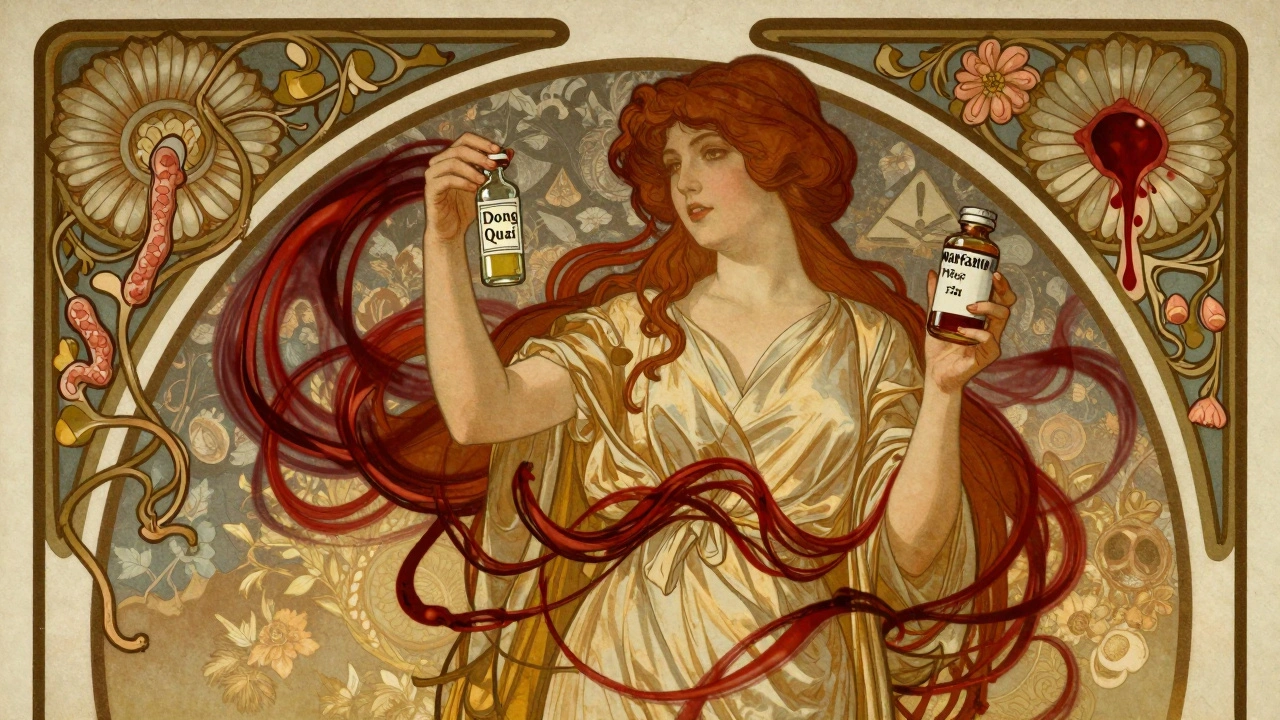
Warfarin-Dong Quai Interaction Calculator
This tool estimates the potential impact of Dong Quai on your INR (International Normalized Ratio) while taking warfarin. Remember: this is for educational purposes only and not a substitute for medical advice.
Estimated Impact
If you're taking warfarin to prevent blood clots, and you're also using Dong Quai for menopause, cramps, or just because you think it's "natural"-you need to stop and listen. This isn't a theory. It's a real, documented risk that has sent people to the hospital. Dong Quai doesn't just sit quietly beside your prescription. It teams up with warfarin and makes your blood thinner than it should be. And that can lead to dangerous bleeding-inside your brain, your stomach, even under your skin.
What Is Dong Quai, Really?
Dong Quai, or Angelica sinensis, is a root used in Traditional Chinese Medicine for over 2,000 years. It’s often called "female ginseng" because it’s commonly taken for menstrual pain, hot flashes, and other hormonal symptoms. You’ll find it in teas, capsules, tinctures, and even some beauty products marketed as "hormone-balancing." It’s popular. And it’s sold everywhere-from online supplement stores to local herbal shops in Perth, Sydney, and beyond.
But here’s the catch: Dong Quai contains natural compounds called coumarins, including ferulic acid and osthole. These aren’t just harmless plant chemicals. They interfere with how your blood clots. In fact, they work in the same way warfarin does-just through different paths. That’s the problem.
How Warfarin Works-and Why It’s So Sensitive
Warfarin is one of the most common blood thinners in the world. Over 30 million prescriptions are filled for it every year in the U.S. alone. It doesn’t dissolve clots. It stops new ones from forming by blocking vitamin K, which your liver needs to make clotting proteins. Your doctor checks your INR (International Normalized Ratio) regularly to make sure your blood is thin enough to prevent clots, but not so thin that you bleed out.
The target INR for most people is between 2.0 and 3.0. Go above 4.0? Your risk of major bleeding jumps sharply. Go below 2.0? Clots start forming again. It’s a tightrope walk. And Dong Quai doesn’t just nudge you off balance-it shoves you.
The Interaction: More Than Just a Theory
Some people say, "There’s no solid proof." But that’s misleading. There’s plenty of proof-just not always from huge human trials. Why? Because you can’t ethically give people warfarin and Dong Quai to see if they bleed. So most evidence comes from case reports, animal studies, lab tests, and real-world patient experiences.
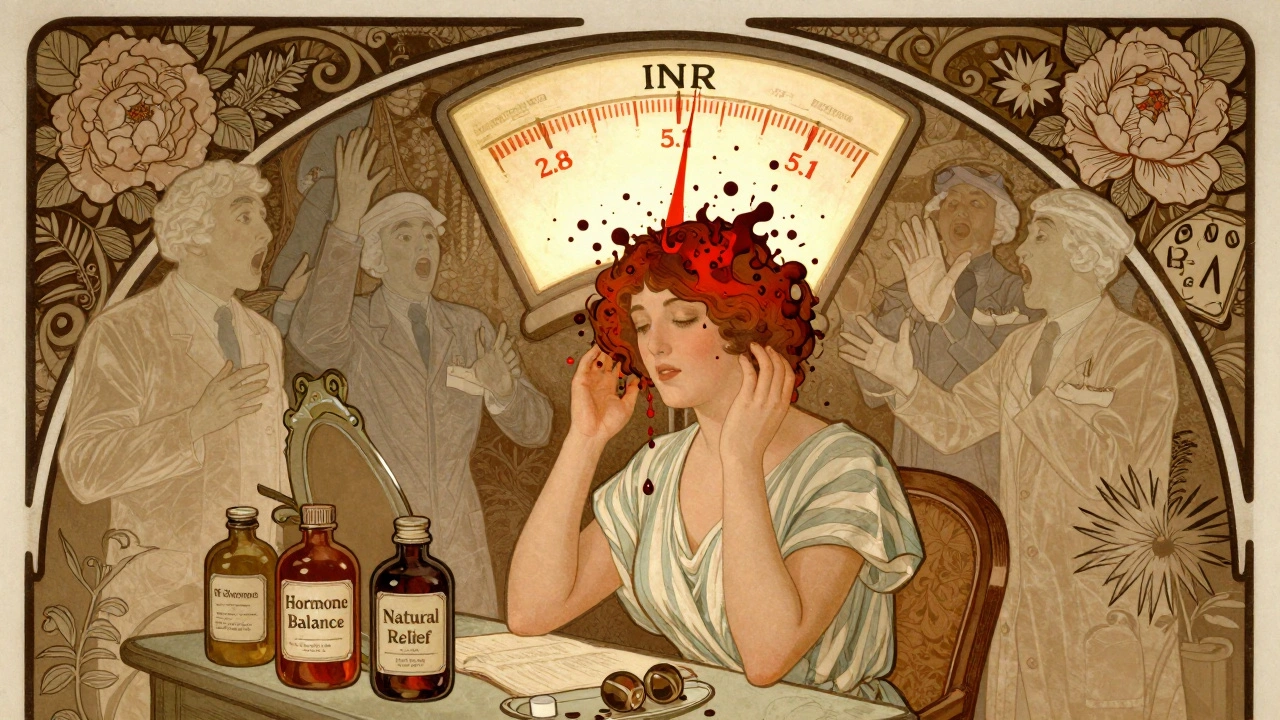
A 2013 review in PLOS ONE found that Dong Quai was one of 90 Chinese herbs linked to dangerous interactions with blood thinners. In one documented case, a woman on warfarin started taking Dong Quai for menopause. Her INR jumped from 2.8 to 5.1 in just two weeks. She ended up in the hospital. Another Reddit user shared a similar story: INR went from 2.5 to 4.9 after starting Dong Quai. No trauma. No injury. Just a supplement.
Studies show Dong Quai doesn’t just make warfarin stronger-it also directly stops platelets from sticking together. That’s a second way it thins your blood. So even if warfarin levels stay the same, your blood still clots slower. This is called a pharmacodynamic interaction. It’s not about how your body processes the drug. It’s about what the drug and the herb do together.
And here’s the kicker: Dong Quai might also slow down how your liver breaks down warfarin. Some lab studies suggest it blocks enzymes (CYP2C9 and CYP3A4) that clear warfarin from your system. That means warfarin sticks around longer, building up to dangerous levels. It’s a one-two punch: more effect from the herb, plus more of the drug left in your body.
What the Experts Say
Major medical groups don’t hedge. They say: avoid Dong Quai if you’re on warfarin.
- The Cleveland Clinic says: "It is recommended to avoid Dong Quai in warfarin-treated patients due to lack of data."
- The University of California San Diego lists Dong Quai under "Increased Risk of Bleeding," right next to ginkgo, garlic, and fish oil.
- The American Heart Association calls it a "high-risk herb" for anticoagulant users.
- The Memorial Sloan Kettering Cancer Center warns not only about bleeding, but also about Dong Quai’s estrogen-like effects-especially risky for people with breast or uterine cancer.
Dr. Catherine Ulbricht, a top pharmacist at Massachusetts General Hospital, put it bluntly: "The additive antiplatelet effects of Dong Quai could push a patient’s INR from a therapeutic range of 2.5 to potentially dangerous levels above 4.0."
And she’s not exaggerating. The annual risk of major bleeding for someone on warfarin is already 1.5-2.5%. Add Dong Quai? That risk could double.
Real-World Data: It’s Happening
You might think this is rare. It’s not.
A 2022 survey by the National Center for Complementary and Integrative Health found that 68% of people taking warfarin didn’t even know herbal supplements could interfere. But when they were told about the risks, 82% said they’d stop using them.
On HealthUnlocked forums, 23 patients reported unexplained INR spikes between 2020 and 2023. All of them had started taking Dong Quai. Their INR rose by an average of 1.7 points-enough to cross into the danger zone. One man’s INR went from 2.3 to 4.6 after taking Dong Quai for three weeks. He had bruising on his legs and nosebleeds. He didn’t realize the supplement was the cause.
Even the FDA has recorded over 140 adverse events linked to herbal products and blood thinners between 2018 and 2022. Dong Quai wasn’t the top offender, but it showed up enough times to be flagged.
Why This Is Hard to Predict
Not all Dong Quai is the same. That’s the scary part.
Unlike prescription drugs, supplements aren’t required to prove they contain what’s on the label. A 2020 test by the United States Pharmacopeia found Dong Quai products varied by up to eightfold in their ferulic acid content. One capsule might be harmless. Another could be a time bomb.
And it gets worse. If you stop taking Dong Quai after using it for weeks, your INR might suddenly drop. That means your blood starts clotting too fast again. You could get a stroke or pulmonary embolism. It’s not just about starting the herb-it’s about stopping it, too.
What Should You Do?
If you’re on warfarin:
- Stop taking Dong Quai immediately. Don’t wait. Don’t "try a little." The risk isn’t worth it.
- Tell your doctor or anticoagulation clinic. Even if you’ve been taking it for months, they need to know. Your INR might need to be checked sooner than scheduled.
- Check every supplement. Dong Quai might be hidden in "women’s health blends," "hormone support," or "natural estrogen balancers." Read the ingredients. If you see "Angelica sinensis," skip it.
- Don’t replace it with another herb. Ginkgo, garlic, ginger, turmeric, and fish oil also raise bleeding risk. They’re not safer alternatives.
If you’re not on warfarin but thinking about taking Dong Quai:
- Ask your doctor if you’re on any other blood thinners-like aspirin, clopidogrel, rivaroxaban, or apixaban. Dong Quai can interact with those too.
- If you have a history of hormone-sensitive cancer (breast, ovarian, uterine), avoid it entirely. It mimics estrogen.
- Just because it’s "natural" doesn’t mean it’s safe. The most dangerous drugs in history were once considered "natural."
What’s Changing?
The world is catching up. In January 2025, the European Medicines Agency will require all Dong Quai products sold in EU countries to carry a warning about warfarin interactions. In the U.S., the FDA is still slow to act-but the American College of Cardiology now lists Dong Quai in the same risk category as St. John’s wort and ginkgo biloba.
A major NIH-funded clinical trial is underway at the University of Illinois, tracking 120 people taking Dong Quai with warfarin. Results are expected in late 2024. But you don’t need to wait for those results to make a decision. The evidence already exists. The warnings are clear. The cases are real.
The market for Dong Quai is growing. Sales hit $342 million in 2022. People are buying it because they believe in natural healing. But healing shouldn’t come with a risk of internal bleeding.
If you’re taking warfarin, your body is already under careful management. Adding Dong Quai is like turning up the volume on a life-saving machine without knowing what it does. It’s not worth the gamble.
Tejas Bubane 7.12.2025
Dong Quai is just another example of people trusting ancient remedies over peer-reviewed science. You don't get to bypass pharmacology because something grew in the ground. The fact that it inhibits CYP2C9 and platelet aggregation isn't speculation-it's biochemistry. If you're on warfarin and still taking this, you're not holistic, you're reckless.
Ajit Kumar Singh 7.12.2025
People in India have been using this for centuries and we never had problems until western doctors started overcomplicating everything. You think your INR numbers are sacred? We boiled this root for generations and no one bled out. Your medicine is too obsessed with numbers and too blind to tradition. This is cultural arrogance wrapped in lab coats.
Maria Elisha 7.12.2025
So like… if I’m on warfarin, I just can’t have any herbal tea anymore? What’s next, no green tea? No turmeric lattes? I feel like the whole thing’s being blown out of proportion. I’ve seen people take this for years and they’re fine.
Lisa Whitesel 7.12.2025
It’s not about being scared of herbs. It’s about being too stupid to read the label. You don’t mix anticoagulants with anything that has coumarin unless you want to end up in a body bag. If you’re taking Dong Quai, you’re not a wellness warrior-you’re a walking liability.
Larry Lieberman 7.12.2025
Just had my INR checked yesterday-2.9. I stopped Dong Quai 3 weeks ago. My doc said it dropped 1.2 points since I quit. 🤯 I thought it was just stress. Turns out my "natural estrogen balancer" was trying to turn me into a human sieve. Lesson learned. Don't trust anything labeled "herbal remedy."
Sabrina Thurn 7.12.2025
Pharmacodynamic interactions with CYP450 enzymes and antiplatelet effects are well-documented in the literature-this isn't anecdotal. The real issue is the lack of standardization in botanicals. A 500mg capsule of Dong Quai can contain anywhere from 2.1mg to 17.8mg of ferulic acid depending on the batch. That’s a 750% variability. No pharmaceutical drug would be approved with that kind of inconsistency. The FDA’s inaction here is indefensible.
Richard Eite 7.12.2025
Why are we even having this conversation? If you're on warfarin, you don't touch anything not approved by your doctor. Period. No exceptions. No "natural" excuses. This isn't a debate-it's basic safety. Stop being dumb.
Ronald Ezamaru 7.12.2025
I get why people turn to Dong Quai. Menopause is brutal, and Western medicine doesn’t always offer kind solutions. But this isn’t about shaming. It’s about awareness. If you’re taking it, talk to your anticoagulation nurse. Get your INR checked. There’s no shame in wanting relief-but there’s real danger in ignoring the science. We can honor tradition and still protect lives.