

Polypharmacy Risk Assessment Tool
This tool helps assess your risk of adverse drug events based on the number of medications you take. The article explains that each additional medication increases fall risk by 8%. For best results, complete a Type III medication review with a pharmacist or geriatrician.
When older adults take five or more medications, they’re not just managing health-they’re playing Russian roulette with their safety. Every extra pill increases the chance of a fall, a hospital trip, or even death. This isn’t rare. Nearly 41% of Americans over 65 are on five or more drugs. And 19% are on ten or more. The problem isn’t that doctors are careless. It’s that the system is broken. Too many providers, too little coordination, and too little time to ask: Do you still need this?
Why Polypharmacy Is a Silent Crisis
Polypharmacy isn’t just about having a lot of pills. It’s about taking drugs that don’t belong together-or that don’t belong at all. A 78-year-old with arthritis might be on ibuprofen, a blood pressure pill, a statin, a sleep aid, and an anticholinergic for overactive bladder. Each one makes sense alone. Together? They double the risk of confusion, dizziness, and falls. Research from the Journal of the American Geriatrics Society shows each additional medication raises fall risk by 8%. That’s not a small bump. That’s a landslide. And it’s not just falls. Medication-related hospitalizations make up nearly 28% of all admissions for seniors. Most of these are preventable. A 2022 study by the Institute for Safe Medication Practices found that over half of these hospital stays happened because someone was taking a drug that no longer helped-or was actively harming them.What Works: The Three Levels of Intervention
Not all medication reviews are created equal. There are three types, and only one makes a real difference.- Type I: Just looking at the list. No conversation. No follow-up. Doesn’t work.
- Type II: Adds adherence checks-did they take it? Still doesn’t work.
- Type III: Face-to-face (or video) review with a pharmacist or geriatrician who looks at the whole picture: symptoms, goals, life expectancy, and whether each drug still makes sense. This one cuts hospital readmissions by 18.3%.
Tools That Actually Guide Decisions
There are three big tools used to decide what to stop:- Beers Criteria (2023 update): Lists drugs to avoid in seniors. Helpful, but doesn’t tell you when to stop.
- STOPP/START v3 (2021): Stops inappropriate drugs, starts needed ones. Proven to reduce harm.
- FORTA (Fit for the Aged): Rates drugs by benefit-risk for older adults. Shows which ones are worth keeping.
Who Does It Best? Pharmacists Lead the Way
Doctors are stretched thin. The average primary care visit is 15 minutes. You can’t review 12 medications in 5 of those. That’s why pharmacist-led programs are the most effective. A 2025 study found that when pharmacists work under Collaborative Practice Agreements (CPAs), they deprescribe at a rate 37.6% higher than doctors alone. Why? They have the time. They’re trained. They know the tools. And in places like the Veterans Health Administration, embedded pharmacists cut inappropriate prescriptions by 26.8%. But here’s the catch: Only 22 U.S. states allow CPAs. In the rest, pharmacists can’t legally adjust prescriptions-even if they know it’s the right thing to do. That’s not a clinical problem. That’s a policy failure.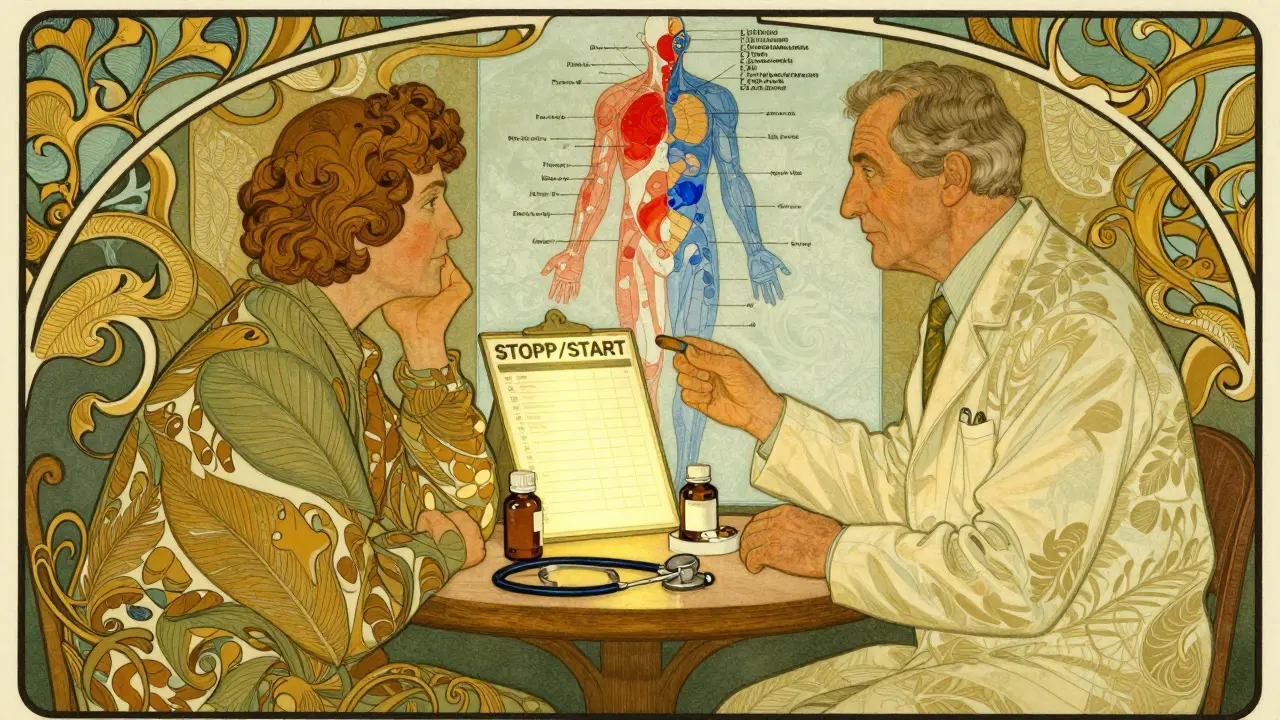
Who Benefits Most? Not Everyone
This isn’t one-size-fits-all. The biggest gains come from patients aged 65-79. Those over 80? Benefits shrink. Why? Frailty, cognitive decline, and competing priorities. A 2023 subanalysis showed a 14.7% drop in mortality for younger seniors-but only 5.2% for those 80+. And patients with dementia? They get 19.3% less benefit from interventions. Why? Because they can’t tell you how they feel. Their families might not know the meds. And the risk of withdrawal reactions is higher. The key insight? Deprescribing works best when patients are engaged, cognitively intact, and have clear goals. If someone says, “I just want to stop feeling dizzy,” and you take away their antihistamine, they’ll thank you. If you pull a heart medication from someone with advanced dementia who’s not at risk for a heart attack? You might hurt them.What Goes Wrong: The Dark Side of Deprescribing
Stopping meds isn’t always safe. A 2023 study in the Journal of General Internal Medicine found that 7.3% of patients had disease flare-ups after abrupt withdrawal. One man stopped his beta-blocker too fast and ended up in the ER with uncontrolled atrial fibrillation. Another had seizures after quitting a seizure drug without tapering. That’s why protocols matter. You don’t just delete a pill. You:- Check if it’s truly inappropriate (using STOPP/START or FORTA)
- Assess withdrawal risk (e.g., benzodiazepines, SSRIs, steroids)
- Plan a slow taper
- Monitor symptoms for 4-8 weeks
- Reassess with the patient
The Real Barriers: Time, Money, and Fragmented Care
Even when everyone agrees deprescribing is good, it rarely happens. Why?- Time: 78% of primary care doctors say they have less than 5 minutes per patient to review meds.
- Money: Only 15% of Medicare Advantage plans pay for full medication reviews. No reimbursement? No service.
- Fragmentation: The average senior sees 5+ providers a year. No one has the full list. One doctor prescribes. Another doesn’t know. A third stops something without telling anyone.
- Patient fear: 68% of older adults are terrified of stopping meds-even when told it’s safe.
The Future: AI, Payment Shifts, and What’s Coming
Change is coming. In April 2024, Epic Systems launched the “Polypharmacy Risk Score”-an AI tool that predicts which patients are most likely to have a bad drug reaction. It’s 87.3% accurate. That’s not science fiction. That’s now. Medicare is watching. Starting in 2024, providers with more than 30% of patients on 10+ medications face penalties under MIPS. That’s not a suggestion. That’s a financial hammer. And by 2030, experts predict comprehensive medication reviews will be standard care for seniors. Why? Because value-based care pays for outcomes-not volume. Hospitals that reduce preventable admissions save money. Patients who don’t fall stay independent. Everyone wins.What You Can Do Right Now
If you’re a caregiver or a senior:- Bring a full list of every pill, patch, and supplement to every appointment-even if you think it’s not important.
- Ask: “Is this still helping me? What happens if I stop it?”
- Request a pharmacist-led medication review. Ask your doctor if one is available.
- Don’t be afraid to say no to a new prescription unless you understand why it’s needed.
- Use STOPP/START or FORTA-not just Beers Criteria.
- Block 30 minutes every day for medication reconciliation.
- Partner with a clinical pharmacist. Even one hour a week changes outcomes.
- Track adherence. If you don’t know if they’re taking it, you don’t know if it’s working.
Final Thought: It’s Not About Numbers. It’s About Life.
The goal isn’t to cut pills for the sake of cutting pills. It’s to help someone sleep better, walk without fear, stay out of the hospital, and feel like themselves again. A 72-year-old woman stopped her nighttime antihistamine and started sleeping through the night. She stopped falling. She stopped being afraid. That’s not a statistic. That’s a life restored.What is considered polypharmacy in older adults?
Polypharmacy is generally defined as taking five or more medications regularly. This threshold is used by major organizations like the American Geriatrics Society and the American Academy of Family Physicians. While some experts look at the appropriateness of drugs rather than just the count, the five-medication mark is the standard used in research and clinical guidelines to flag increased risk of adverse events.
Which tools are most effective for identifying inappropriate medications?
The most effective tools are STOPP/START (v3, 2021) and FORTA (Fit for the Aged). Both are evidence-based and have been shown in clinical trials to reduce hospitalizations and improve outcomes. Beers Criteria is widely used but doesn’t guide when to start or stop drugs-it only lists ones to avoid. For real-world impact, STOPP/START and FORTA are superior because they balance risks and benefits.
Can deprescribing cause harm?
Yes, if done too quickly or without monitoring. Abruptly stopping drugs like benzodiazepines, antidepressants, or steroids can cause withdrawal symptoms, seizures, or disease rebound. A 2022 study found 12.4% of patients had adverse events from rushed deprescribing. Safe deprescribing means tapering slowly, watching for symptoms, and rechecking with the patient after 4-8 weeks.
Why are pharmacists more effective than doctors at deprescribing?
Pharmacists have specialized training in drug interactions, side effects, and dosing in older adults. They also have more time-unlike physicians, who often have 5-10 minutes per patient. Under Collaborative Practice Agreements, pharmacists can legally adjust prescriptions, leading to 37.6% higher deprescribing rates than physician-only approaches. Their focus is purely on medication safety, not other aspects of care.
Is polypharmacy reduction covered by Medicare?
Most Medicare Advantage plans do not currently pay for comprehensive medication reviews. Only 15% offer specific reimbursement for pharmacist-led reviews. Medicare fee-for-service pays for some medication therapy management services, but only under strict conditions. This lack of payment is a major barrier to widespread implementation.
What’s new in 2025 for geriatric polypharmacy?
In 2025, the American Geriatrics Society is releasing Beers Criteria v2026, which will include new deprescribing algorithms. AI tools like Epic’s Polypharmacy Risk Score are now in use and can predict adverse drug events with 87.3% accuracy. Also, CMS is penalizing providers with high rates of patients on 10+ medications through the MIPS program, pushing health systems to act.
Marissa Staples 24.03.2026
It’s funny how we treat aging like a disease to be managed with more pills. But life isn’t a spreadsheet. You can’t optimize a human being by subtracting medications like they’re unnecessary apps on a phone. What matters isn’t the number-it’s whether someone can still smell coffee, hug their grandkid without falling, or sleep through the night. That’s the real metric.
Rachele Tycksen 24.03.2026
so like… if u stop all the meds do u just turn into a zen master? lol
Grace Kusta Nasralla 24.03.2026
I think about my mom… she took seven pills a day. Said she didn’t want to be a burden. But she stopped laughing. Stopped walking to the mailbox. Just sat there. Quiet. I asked the doctor to cut one. He said ‘it’s not that simple.’
But maybe… it is.
Korn Deno 24.03.2026
The system is designed to prescribe, not to pause. We’ve turned healthcare into a volume business. Doctors get paid for adding, not subtracting. Pharmacists know this better than anyone. The real innovation isn’t in the drugs-it’s in giving them the legal power to say ‘no.’
Stop treating deprescribing like a loophole. Treat it like standard care.
Pat Fur 24.03.2026
I’m from rural Arkansas. My neighbor’s 74-year-old wife stopped her sleeping pill after a pharmacist sat with her for 45 minutes. Said she finally slept like she did in 1989. No more fog. No more falls.
That’s not data. That’s dignity.
James Moreau 24.03.2026
Pharmacists being legally blocked from adjusting prescriptions is absurd. We let them fill prescriptions, counsel on side effects, and catch dangerous interactions-but not change them? That’s like letting a mechanic diagnose your engine but not turn the wrench.
We need policy change, not just better guidelines.
J. Murphy 24.03.2026
they say 5+ meds is bad but what if u need all 5? some people are just sick. stop being so woke about pills
Jesse Hall 24.03.2026
This hit home. My dad was on 11 meds. We did a Type III review. Cut 4. He started gardening again. Smiled more. Said he felt like himself for the first time in years.
Don’t let bureaucracy steal your loved one’s joy. Ask for the pharmacist. Push for it. It works.
Alex Arcilla 24.03.2026
Oh wow, a whole article about cutting pills and nobody mentioned Medicare’s 15% reimbursement rate? Of course it’s not happening. You can’t fix a broken system with good intentions and a clipboard.
And yeah, doctors have 5 minutes? That’s not negligence. That’s capitalism.
Kevin Y. 24.03.2026
It is imperative to recognize that deprescribing, when executed with meticulous clinical judgment and under the supervision of qualified healthcare professionals, represents not merely a reduction in pharmaceutical burden, but a restoration of autonomy and quality of life for the geriatric population. The evidence base is unequivocal.
Raphael Schwartz 24.03.2026
They just want to take away your meds so the government can save money. Next they’ll take your coffee. Or your TV. Or your dignity. This is socialism in disguise.
Aaron Sims 24.03.2026
AI predicting drug reactions? 87.3% accurate? That’s just the algorithm learning to say ‘stop everything’ because it’s easier than thinking. What about the guy who stopped his beta-blocker and died? Who’s liable? Who’s gonna pay? This isn’t healthcare. It’s a tech demo with a side of blame.
Stephen Alabi 24.03.2026
It is disingenuous to suggest that pharmacists are inherently more competent than physicians in evaluating polypharmacy. While pharmacists possess specialized knowledge regarding pharmacokinetics, the holistic clinical assessment-including comorbidities, prognostic indicators, and psychosocial context-remains the domain of the physician. To subordinate clinical judgment to pharmacy-led protocols is to invite iatrogenic harm.
Agbogla Bischof 24.03.2026
As a pharmacist from Nigeria, I’ve seen this in our clinics too. Elderly patients on 10+ drugs because no one coordinated care. We started using FORTA. Reduced hospital visits by 30% in 6 months. No fancy tech. Just time, training, and trust.
It’s not about money. It’s about respect.