

Why biosimilars aren’t just generic drugs
When you think of a generic drug, you probably picture a small pill that looks different from the brand-name version but does the same thing. That’s straightforward. But biosimilars? They’re not like that at all. A biosimilar is a biologic drug - a large, complex molecule made inside living cells - that’s designed to be as close as possible to an already-approved reference biologic. Think of it like trying to recreate a handmade Swiss watch using only photos of the original, without ever seeing the tooling or knowing the exact sequence of steps the original maker used. That’s the reality of biosimilar manufacturing.
Unlike small-molecule generics, where chemists can replicate the exact same chemical structure using predictable reactions, biosimilars are built by living cells - usually Chinese hamster ovary (CHO) cells or bacteria - that produce proteins with tiny, unpredictable variations. These aren’t just minor differences. They can affect how the drug works in your body. A single change in sugar attachments (glycans) on a protein can alter how long it lasts in your bloodstream or whether your immune system reacts to it. That’s why saying a biosimilar is "similar" isn’t just marketing. It’s a scientific and manufacturing feat.
The "process defines the product" problem
The biggest hurdle in making biosimilars is this: the process defines the product. That means the way you grow the cells, feed them, control the temperature, and purify the final molecule all determine what the drug ends up being. Even if two companies use the same gene sequence to make the same protein, if one uses a different type of culture media or runs its bioreactor at 37.2°C instead of 36.8°C, the final product can be measurably different.
Developers don’t get access to the originator’s exact manufacturing recipe. They have to reverse-engineer it by testing hundreds of variables. One study showed that over 150 critical quality attributes (CQAs) need to be matched - from protein folding to charge variants to glycosylation patterns. Each one has to fall within a narrow range to prove biosimilarity. This isn’t guesswork. It’s high-stakes detective work with millions of dollars on the line.
Glycosylation: The silent game-changer
One of the most difficult things to control is glycosylation - the sugar chains attached to the protein. These aren’t just decorations. They’re functional. A change in just one sugar molecule can make the drug clear from your body faster, reduce its ability to bind to target cells, or trigger unwanted immune responses.
These sugars are added by the cell’s own machinery, which responds to tiny changes in its environment. Even switching from one batch of fetal bovine serum to another can shift glycosylation patterns. Manufacturers have to test dozens of media formulations, oxygen levels, pH buffers, and feeding schedules to get the same glycan profile as the reference product. It’s like trying to bake the same cake using different ovens, flour brands, and humidity levels - and having to prove every slice tastes exactly the same.

Scaling up: Bigger tanks, bigger problems
Getting a biosimilar to work in a 5-liter lab bioreactor is one thing. Getting it to work in a 2,000-liter commercial tank is another. At larger scales, mixing isn’t uniform. Oxygen doesn’t distribute evenly. Temperature gradients form. Cells in one corner get more nutrients than those in another. These differences can lead to inconsistent protein quality batch after batch.
Companies have to spend years optimizing conditions for scale-up. They test agitation speeds, sparging rates, and feeding strategies to make sure cells in a big tank "feel" the same as cells in a small one. Many smaller manufacturers can’t afford the capital investment to build these large-scale facilities. That’s why most biosimilars today come from just a handful of big players with global manufacturing networks.
Supply chain and cold chain nightmares
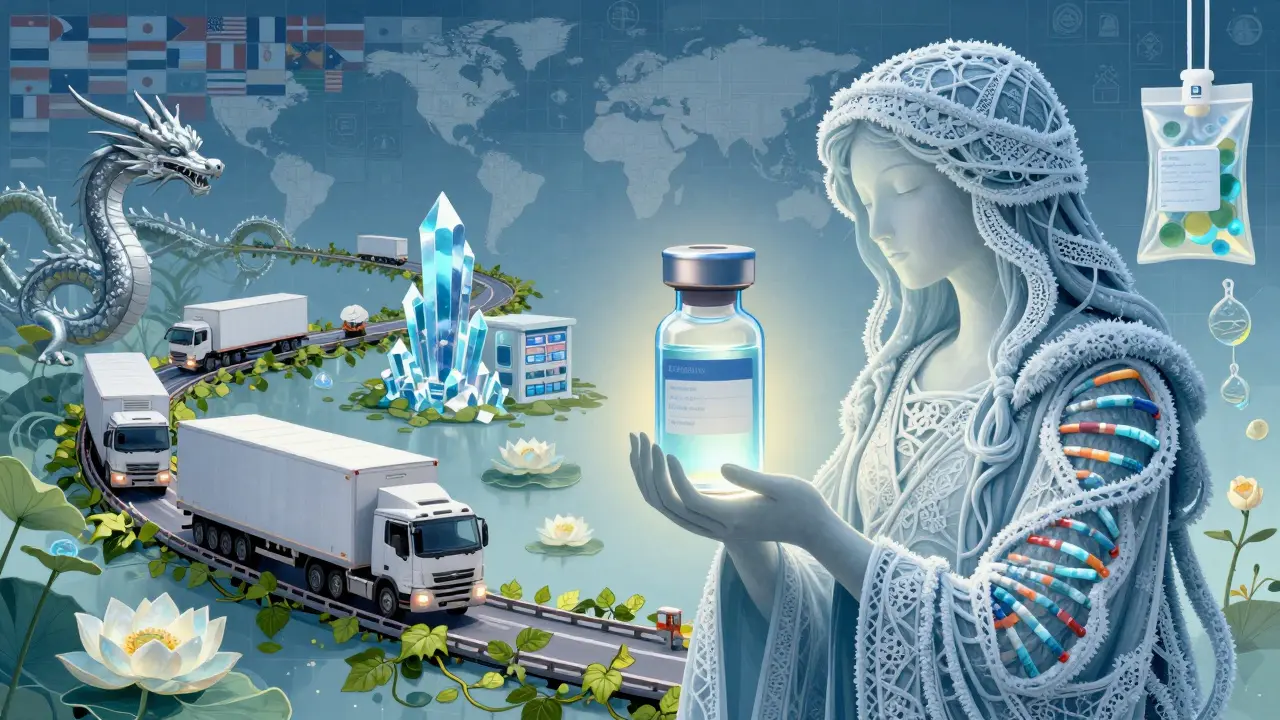
Biosimilars are fragile. They can degrade if exposed to heat, light, or even vibration. That’s why they need a tight cold chain - constant refrigeration from the factory to the hospital. One broken refrigerated truck, one mislabeled storage unit, and an entire batch can be ruined. These aren’t cheap drugs. A single batch can cost over $1 million to produce. Losing it isn’t just a financial hit - it can cause drug shortages.
Even the containers matter. Traditional stainless steel tanks require cleaning and sterilization between batches, which takes time and introduces contamination risk. That’s why more manufacturers are switching to single-use bioreactors - plastic bags that come pre-sterilized and are thrown away after use. They cut cleaning time by 70%, reduce contamination risk, and let companies switch between products faster. But they’re expensive, and sourcing them reliably is a challenge in itself.
Regulatory maze: One country, different rules
Getting a biosimilar approved isn’t a single step. It’s a multi-phase marathon. You need to show analytical similarity - proving your molecule matches the reference in structure and function. Then you need preclinical data - animal studies to show it behaves the same. Finally, you need clinical trials - usually a pharmacokinetic study and sometimes an efficacy or safety trial.
The problem? Each country has different expectations. The FDA in the U.S. might accept a single PK study. The EMA in Europe might require an additional clinical trial. India’s regulators have their own guidelines. And all of them demand access to state-of-the-art labs with mass spectrometers, NMR machines, and high-resolution chromatography systems. Few companies have the expertise - or the budget - to meet all these requirements across multiple markets.
Technology is helping - but it’s not a magic fix
There’s hope. New tools are making biosimilar manufacturing more predictable. Process analytical technology (PAT) lets manufacturers monitor critical parameters in real time - like pH, dissolved oxygen, and cell density - and adjust on the fly. Artificial intelligence is being used to predict how changes in feed composition will affect glycosylation before a single batch is run. Automation reduces human error in filling and packaging.
Continuous manufacturing - where the process runs nonstop instead of in batches - is also gaining traction. It reduces variability and can cut production time by half. But these technologies require deep expertise and big investments. Only companies with strong R&D budgets and regulatory experience can implement them effectively.
Why this matters for patients
Biosimilars are meant to lower the cost of life-saving biologics - drugs for cancer, autoimmune diseases, and rare conditions that can cost over $100,000 a year. The global biosimilars market is expected to hit $58 billion by 2030. But if manufacturing is too complex, too slow, or too risky, prices won’t drop as much as they should. Supply shortages can still happen. Patients might wait longer. Doctors might hesitate to switch.
The real win isn’t just having more biosimilars on the market. It’s having reliable, consistent, affordable ones - made by manufacturers who understand that every cell, every sugar, every temperature setting matters.
What’s next?
The next wave of biosimilars will include even more complex molecules - bispecific antibodies, antibody-drug conjugates, fusion proteins. These require extra purification steps, refolding, and precise conjugation chemistry. Each adds another layer of risk. The companies that will win are the ones who treat biosimilar manufacturing not as a cost-cutting exercise, but as a science-driven, precision engineering challenge.
For now, the bar remains high. Only those who can master the invisible variables - the glycosylation, the scale-up, the cold chain, the regulatory shifts - will survive. And that’s why, despite the hype, true biosimilar success is still rare.
Are biosimilars the same as generic drugs?
No. Generic drugs are exact chemical copies of small-molecule drugs and can be made using standard synthesis. Biosimilars are highly similar versions of complex biologic drugs made in living cells. They can’t be identical because biological systems introduce natural variability. Even tiny differences in manufacturing can affect how the drug works in the body.
Why is glycosylation such a big deal in biosimilars?
Glycosylation refers to the sugar chains attached to proteins in biologics. These sugars affect how long the drug stays in the body, how well it binds to its target, and whether the immune system reacts to it. Even small changes in glycosylation patterns - caused by differences in cell culture conditions - can impact safety and effectiveness. Matching the reference product’s glycan profile is one of the hardest parts of biosimilar development.
Can biosimilars cause unexpected side effects?
Regulatory agencies require extensive testing to ensure biosimilars have no clinically meaningful differences in safety or effectiveness compared to the reference product. While rare immune reactions can occur - as they can with any biologic - approved biosimilars have not shown higher rates of side effects in real-world use. The key is consistent manufacturing. If quality control fails, risk increases.
Why are biosimilars so expensive to make?
Biosimilars require living cells, complex purification systems, sterile environments, and advanced analytical tools to prove similarity. Building and validating a manufacturing facility can cost over $200 million. Single-use systems, automation, and cold chain logistics add further expense. Unlike generics, you can’t just copy a formula - you have to rebuild the entire biological process from scratch.
How long does it take to develop a biosimilar?
It typically takes 7 to 10 years from initial research to market approval. Around 3 to 5 years are spent on process development and analytical characterization, 1 to 2 years on preclinical studies, and another 2 to 3 years on clinical trials and regulatory review. The timeline can be longer if regulatory agencies request additional data or if scale-up issues arise.
Are biosimilars available in all countries?
No. While the U.S., EU, Canada, Japan, and Australia have well-established biosimilar pathways, many low- and middle-income countries lack the regulatory infrastructure, lab capabilities, or supply chain to approve or distribute them reliably. Even where approved, access can be limited by pricing, procurement policies, or physician familiarity with the drugs.
lokesh prasanth 19.01.2026
biosimilars are just pharma's way of charging 100k for a copy that's 99% the same. they call it science but it's just rent-seeking with a lab coat.
MARILYN ONEILL 19.01.2026
i dont even know what glycosylation means but i know it sounds fancy so they can charge more. this is why healthcare is broken.
Samuel Mendoza 19.01.2026
you say it's hard but i bet big pharma makes it harder on purpose to keep prices high. this isn't science, it's a monopoly game.
Malvina Tomja 19.01.2026
Let me break this down for you like you're five: if you can't replicate a molecule perfectly, it's not a generic. It's a glorified knockoff with a $200M price tag. And don't even get me started on the regulatory theater-each agency plays its own version of 'guess what the originator did.' This isn't innovation. It's expensive mimicry with extra steps.
Andrew Rinaldi 19.01.2026
I get why this is hard. Living cells aren't like chemical reactions-you can't just flip a switch and get the same result every time. But that doesn't mean we should give up. Maybe the real win isn't in matching every sugar molecule perfectly, but in making these drugs accessible even if they're not 100% identical. Sometimes good enough, done, is better than perfect, delayed.
Glenda Marínez Granados 19.01.2026
So we're telling a hamster cell to be a Swiss watchmaker... 🤡 And we're surprised it makes a mess? At least the hamster gets a treat at the end.
Steve Hesketh 19.01.2026
This is why I believe in science-but not in the system. The fact that we can make these miracles at all, with all these variables, is insane. And yet, people still say healthcare is too expensive. We’re not paying for the drug-we’re paying for the 10-year battle to make it not kill someone.
michelle Brownsea 19.01.2026
The notion that 'process defines the product' is not merely a technical observation-it is a philosophical truth. The materiality of life cannot be divorced from its methodology. To attempt to replicate a biologic without replicating its genesis is to engage in ontological fraud. The regulatory agencies know this. The public does not.
Yuri Hyuga 19.01.2026
This is the future of medicine-and it’s beautiful. 🚀 Yes, it’s complex. Yes, it’s expensive. But imagine a world where a kid with rheumatoid arthritis gets a $5,000 treatment instead of $100,000. That’s not just science-that’s justice. Keep pushing. The tech is catching up. We’re not there yet, but we’re closer than ever.
shubham rathee 19.01.2026
the cold chain is just a distraction the real issue is the government letting big pharma control the patents for 20 years then pretending they care about biosimilars
MAHENDRA MEGHWAL 19.01.2026
The fidelity of glycosylation patterns is not merely an analytical challenge; it is a biological imperative. The post-translational modifications are not artifacts-they are functional determinants. To underestimate their significance is to risk clinical misalignment. The regulatory standards, though fragmented, remain necessary.
Gerard Jordan 19.01.2026
I work in a clinic in rural Texas. We had a patient on a biosimilar for psoriasis-same drug, 80% cheaper. She cried when she found out she could afford it. That’s what this is about. Not perfect science. Not regulatory trophies. Real people getting real treatment. Don’t let the complexity blind you to the human impact.
Kevin Narvaes 19.01.2026
so like... the cells are drunk and making weird proteins and we just gotta hope they dont kill anyone? lol
Ashok Sakra 19.01.2026
you think this is bad wait till they start making biosimilars of biosimilars. then we'll have biosimilars of biosimilars of biosimilars. who even knows what's in the bottle anymore? it's all a scam.