

When your stomach feels bloated after a small meal, you’re gassy all day, and diarrhea or constipation won’t quit - it might not just be IBS. For many people, the real culprit is something deeper: Small Intestinal Bacterial Overgrowth, or SIBO. It’s not rare. In fact, up to 85% of people diagnosed with IBS may actually have SIBO. But here’s the problem: most doctors don’t test for it. And even when they do, the tests aren’t perfect.
What Exactly Is SIBO?
Your small intestine is supposed to be mostly clean. Unlike your colon, which holds trillions of bacteria that help digest fiber, the small intestine should have fewer than 100,000 bacteria per milliliter. When that number jumps - say, to a million or more - you’ve got SIBO. These extra bugs start fermenting food too early, producing gas, causing bloating, and damaging the gut lining. That’s why people with SIBO often feel awful after eating carbs, dairy, or even fruits. The condition isn’t new. Doctors noticed it in the 1940s, but it wasn’t until the 1970s that Dr. Robert Levitt figured out how to detect it using breath tests. Today, we know SIBO isn’t just about bad digestion. It’s linked to things like past stomach surgery, long-term use of acid-reducing drugs like proton pump inhibitors (PPIs), slow gut motility, diabetes, and even liver disease.How Do You Test for SIBO?
There are two main breath tests: glucose and lactulose. Both work the same way - you drink a sugar solution, then breathe into a bag every 15 to 20 minutes for about two hours. The machine measures gases your gut bacteria produce: hydrogen, methane, or both.- Glucose breath test: You drink 10 grams of glucose in water. Glucose gets absorbed quickly in the upper small intestine. If you’re producing gas early - within 60 minutes - it suggests bacteria are there. This test is better at catching SIBO in the first part of the small intestine. It’s more specific (83% accurate) but misses a lot of cases because it doesn’t reach the lower areas.
- Lactulose breath test: You drink 10 grams of lactulose. It’s not absorbed by your body, so it travels all the way down. If you have gas spikes later - after 90 minutes - it could mean bacteria are hanging out further along. This test catches more cases, but it’s less specific. Up to 20% of healthy people show false positives because their gut moves too fast.
Both tests need strict prep. You have to fast for 12 hours. No antibiotics for 4 weeks. No laxatives or prokinetics for 7 days. Even one bite of bread or a sip of juice the day before can throw off results. A 2023 study found that 30% of failed tests were due to patients not following the diet.
There’s another layer: methane. About 30-40% of people with SIBO produce methane instead of - or in addition to - hydrogen. Methane is linked to constipation. If your test doesn’t measure methane, you’re missing half the picture. That’s why modern labs test for both.
Why Breath Tests Are Controversial
Here’s the truth: breath tests aren’t foolproof. A 2019 review of 1,843 patients found the lactulose test correctly identified SIBO in only 62% of cases. The glucose test? Just 46%. That means nearly half the time, the test says you’re fine when you’re not. Why? Three big reasons:- False negatives: Some people don’t produce hydrogen or methane. Their bacteria make other gases we can’t measure. These people slip through the cracks.
- False positives: If your gut moves too fast - common in IBS - the sugar reaches bacteria too early. The test says SIBO, but it’s just rapid transit.
- No standardization: One lab calls a 10 ppm rise positive. Another says 20 ppm. One uses glucose. Another uses lactulose. No two labs test the same way.
That’s why some experts, like Dr. Eamonn Quigley, say breath tests should only be used as a screening tool - not a diagnosis. Others, like Dr. Mark Pimentel, argue it’s still the best we’ve got. The NIH puts it bluntly: “Results must be interpreted thoughtfully, keeping the clinical context in mind.”
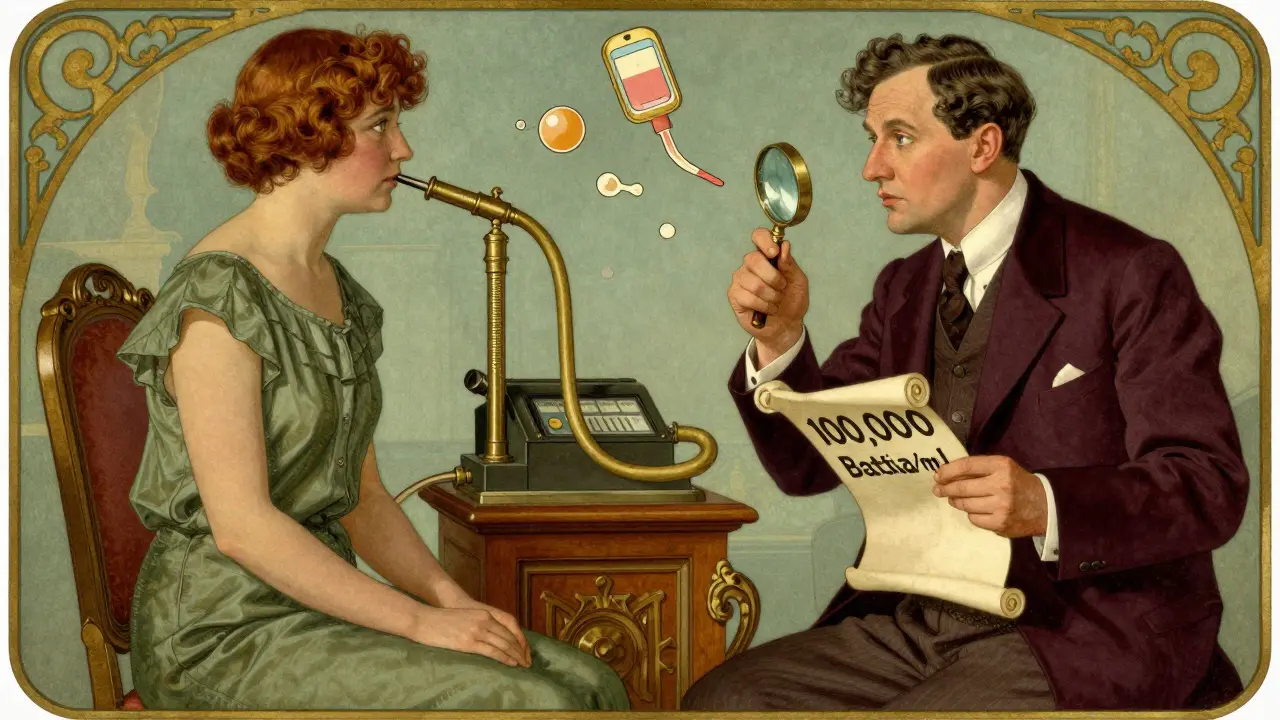
The Gold Standard: A Fluid Sample From Your Small Intestine
The only way to be 100% sure is to get a sample of fluid from your small intestine. Doctors do this with an endoscope - a tube you swallow - and collect fluid just past the ligament of Treitz. If there are more than 100,000 bacteria per milliliter, it’s SIBO. This method is accurate. But it’s expensive ($1,500-$2,500), invasive, and not widely available. Only a handful of centers in the U.S., like UC Davis Health, do it routinely. Even then, contamination rates are high - up to 35% of samples get messed up by mouth bacteria. But here’s the real advantage: with a fluid sample, you can test which antibiotics the bacteria respond to. That means you can pick the right drug. Breath tests can’t do that. You’re guessing.What Happens After a Positive Test?
If your breath test comes back positive, treatment usually starts with antibiotics. Rifaximin (Xifaxan) is the most common - 1,200 mg per day for 10 to 14 days. It’s not absorbed into your bloodstream, so it works right in your gut. Studies show it helps 40-65% of people. But here’s the catch: more than 40% of people come back with symptoms within 9 months. Why? Because antibiotics don’t fix the root cause. If your gut motility is slow, or you’re still on PPIs, or you had surgery - the bacteria will come back. For methane-dominant SIBO, rifaximin alone often fails. Doctors add neomycin - an oral antibiotic that targets methane producers. Combination therapy works better, but it’s harder on the body. Some people try herbal antimicrobials instead - oregano oil, berberine, garlic extract. A 2020 study found they worked just as well as rifaximin in some cases. But they’re not regulated. Dosing varies. Quality control is a mess.
What About Diet?
Diet doesn’t cure SIBO. But it can help you feel better while you’re treating it. The low-FODMAP diet is popular. It cuts out fermentable carbs that feed the bad bacteria. Many people feel better on it. But it’s not a long-term solution. You can’t live on lettuce and chicken forever. The goal isn’t to starve your gut. It’s to rebalance it. After antibiotics, you need to rebuild your microbiome. That means eating fiber again - slowly. Probiotics? Mixed results. Some strains might help. Others could make it worse. There’s no one-size-fits-all.The Future of SIBO Testing
The field is changing fast. Researchers at Cedars-Sinai are testing a new breath analyzer that claims 85% accuracy. Mayo Clinic and Johns Hopkins are working on devices that sample gas directly from the small intestine - no endoscopy needed. Next-generation sequencing might soon let us identify exactly which bacteria are overgrowing. For now, though, we’re stuck with imperfect tools. Breath tests are cheap, quick, and widely available. But they’re not definitive. And without knowing the exact cause - slow motility, low stomach acid, structural changes - treatment is just putting out fires.What Should You Do If You Suspect SIBO?
If you’ve had chronic bloating, gas, or IBS-like symptoms for years - and standard treatments haven’t worked - ask your doctor about SIBO. But don’t just get a breath test and call it done.- Make sure the lab tests for both hydrogen and methane.
- Follow the prep instructions exactly. No exceptions.
- Ask if your doctor has access to small bowel aspirate testing - especially if you’ve had surgery or are not responding to treatment.
- Don’t stop your PPIs or other meds without medical advice.
- Track your symptoms. What foods make you worse? When do you feel bloated? That info matters more than the test number.
SIBO isn’t a death sentence. It’s a signal. Your gut is out of balance. Fixing it takes time, patience, and sometimes, more than one round of treatment. But if you’ve been told it’s just IBS - and nothing helps - it might be time to look deeper.
Noluthando Devour Mamabolo 12.03.2026
Okay but can we talk about how wild it is that we’re still using breath tests like it’s 2007? 🤯 I mean, we have AI that can predict heart attacks from a selfie-yet diagnosing SIBO is still a game of “guess the gas.” I’ve done both tests. Glucose? False negative. Lactulose? False positive. My doctor just shrugged and said “try low-FODMAP.” 😑
Meanwhile, my gut microbiome is throwing a rave and no one’s checking the guest list. We need sequencing. We need real-time sampling. We need to stop treating this like a mystery novel when it’s a damn spreadsheet.
Also-methane? Yeah, that’s the one. Constipation + bloating = methane dominant. If your lab doesn’t report CH4, they’re not trying. 💀
And no, I don’t care if you “don’t believe in SIBO.” My colon doesn’t lie. I’ve been on Rifaximin twice. Third time’s the charm? Maybe. But I’m begging for a biopsy. Anyone know a center that does small bowel aspirates outside of UC Davis? 🙏
Also-emoji alert: 🍽️🚫🥬🧄🧂
Leah Dobbin 12.03.2026
It’s amusing how casually people treat SIBO as if it’s a lifestyle diagnosis rather than a pathophysiological anomaly. The breath test literature is riddled with methodological inconsistencies-yet here we are, armchair gastroenterologists on Reddit prescribing herbal protocols like they’re TED Talk speakers.
The NIH’s cautionary note isn’t a suggestion; it’s a mandate. Clinical context isn’t optional-it’s the cornerstone. To reduce this to a binary “positive/negative” is not just reductive, it’s dangerous. And don’t get me started on the oregano oil cult.
There’s a reason we have gold-standard aspirates. They’re not popular. They’re not cheap. But they’re the only thing that doesn’t rely on wishful thinking.
Ali Hughey 12.03.2026
EVERYONE KNOWS THIS IS A BIG PHARMA COVER-UP. 😱
They don’t want you to know that SIBO is caused by 5G radiation + fluoridated water + GMOs in your kale smoothie. 🌱📡💧
The breath test? A trap. The glucose? A lie. The lactulose? A psyop. They’re testing for “gas” because they don’t want you to know your gut is being poisoned by microchips implanted during your last colonoscopy.
And don’t you DARE take Rifaximin. It’s a Trojan horse. It’s designed to make you dependent on $1,200 prescriptions so Big Pharma can sell you more PPIs. I’ve been researching this since 2017. I’ve talked to 17 whistleblowers. I’ve seen the documents. 📄👁️
My solution? Raw garlic, lemon water, and a Faraday cage around my bed. I’ve been symptom-free for 8 months. They can’t prove otherwise. 😎
P.S. If you’re on a low-FODMAP diet, you’re already part of the system. BREAK THE MATRIX.
Amisha Patel 12.03.2026
Just curious-how many people actually follow the prep for breath tests? I read somewhere that 30% fail because they had a bite of bread. That’s wild. I’d mess it up too. I’m the person who eats oatmeal at 11:30pm thinking ‘it’s not midnight yet.’
Also, I’ve had bloating for years. Tried everything. My doctor said IBS. I didn’t push. But now I’m wondering… should I ask for methane testing? I’m mostly constipated. Not gassy. Is that a clue?
And… is it weird that I feel like I’ve been gaslighted by my own body for 7 years?
Elsa Rodriguez 12.03.2026
OMG I’M NOT ALONE. I’ve been screaming into the void for YEARS. My stomach feels like a balloon filled with helium after ONE banana. My mom says it’s ‘stress.’ My doctor says ‘take a probiotic.’
Then I found a functional doc who tested me for methane. BINGO. 87 ppm. I was so mad I cried. Like… WHY DID NO ONE ASK ME ABOUT MY CONSTIPATION?!
Neomycin + rifaximin? Felt like I got hit by a truck. But I’ve had 3 clean breath tests since. And guess what? I ate sourdough last week. And I didn’t explode. 🎉
STOP TELLING PEOPLE IT’S IBS. IT’S NOT. IT’S SIBO. AND IT’S REAL.
Serena Petrie 12.03.2026
Just get the biopsy. Done.
Buddy Nataatmadja 12.03.2026
My cousin in Indonesia got diagnosed with SIBO after three years of ‘IBS.’ She did the lactulose test, went on Rifaximin, and now eats curry again. No drama. No conspiracy. Just… science.
Also, I’m from Indonesia. We’ve been using turmeric and ginger for gut stuff for centuries. Maybe we should stop pretending Western medicine has all the answers.
mir yasir 12.03.2026
The empirical validity of breath testing in the context of gastrointestinal dysbiosis remains a subject of considerable methodological contention. The current diagnostic paradigm, predicated upon gas chromatographic analysis of exhaled volatile organic compounds, lacks sufficient sensitivity and specificity to serve as a standalone diagnostic modality.
Moreover, the widespread adoption of non-standardized protocols across commercial laboratories introduces unacceptable inter-institutional variability. This undermines the reproducibility of clinical outcomes and compromises the integrity of evidence-based therapeutic decision-making.
Until a consensus is reached on standardization-particularly regarding threshold values and substrate selection-breath testing should remain an adjunct, not a primary diagnostic tool.
Stephanie Paluch 12.03.2026
I’ve been there. The bloating. The confusion. The feeling like your body’s broken.
My breath test was borderline. My doctor said ‘wait and see.’ I didn’t. I started eating slowly. I stopped drinking water with meals. I cut out artificial sweeteners. I started walking after dinner.
Three months later? I feel like me again.
Maybe it wasn’t SIBO. Maybe it was just… my body asking for kindness.
❤️
tynece roberts 12.03.2026
so like… i did the breath test. got a positive. took rifaximin. felt better for like 2 months. then back to bloating. my doc was like ‘try the diet again.’ i’m like… i literally ate lettuce for 6 weeks. i miss bread. i miss pizza. i miss my life.
then i found this guy on tiktok who said ‘just take berberine and don’t eat carbs after 7pm.’ so i did. i still feel kinda weird. but not as bad. idk. maybe i’m just tired of being a lab rat.
also i think i’m allergic to lactulose. i felt like i was gonna die after drinking it. like, full panic attack vibes. why is this stuff so sweet? and why do i have to drink it in 10 minutes? it’s not juice.
Emma Nicolls 12.03.2026
I just want to say thank you for writing this. I’ve been struggling for years and no one ever explained it like this.
I’m starting to feel hopeful again. Not because of a test. But because I finally understand what’s happening.
And if you’re reading this and you’re tired too-you’re not alone.
Jimmy V 12.03.2026
Stop with the breath tests. Get the aspirate. Period.
If you’ve had surgery, are on PPIs, or have diabetes-your gut is a time bomb. Breath tests are like using a flashlight to check for a leak in a submarine. You’re not wrong. You’re just under-equipped.
Find a GI who does this. It’s worth $2K. It’s worth your life. I did it. I’m alive. You can too.
And no, I don’t care if it’s ‘invasive.’ I’d rather be alive and awkward than dead and ‘natural.’
Richard Harris 12.03.2026
Just wanted to say I’ve been on a low fodmap diet for 18 months. I still get bloated. I think I need to ask about methane. I’ve been too scared to ask my doctor. I feel silly. But maybe I shouldn’t.
Thanks for the post. It helped me feel less alone.
Kandace Bennett 12.03.2026
Oh my god, I knew it. This is why I’ve been so angry lately. The whole ‘IBS’ label? It’s a way to gaslight women. You’re not ‘just stressed.’ You’re not ‘just sensitive.’ You have SIBO.
And now I’m mad at every doctor who told me to ‘take a chill pill.’
Also, if you’re using herbal antimicrobials, you’re doing better than 90% of the medical system. I’m proud of you.
🇺🇸 WE NEED BETTER.
Tim Schulz 12.03.2026
So… let me get this straight.
We have a condition that affects up to 85% of IBS patients.
But we diagnose it with a test that’s wrong half the time.
And the only accurate test costs $2,500 and requires you to swallow a tube.
Meanwhile, Big Pharma sells you $1,200 pills that work… sometimes.
And we’re surprised people are angry?
Oh. My. God.
This isn’t medicine. It’s a horror movie with a white coat.
💀🩺