
Medications Don’t Just Suddenly Go Bad on Their Expiration Date
Most people think of expiration dates like a light switch: one day the pill works, the next day it’s useless. That’s not how it works. Medications start losing potency the moment they’re made. The expiration date isn’t a cliff edge-it’s a safety buffer. Manufacturers guarantee that until that date, your medicine will still contain at least 90% of the active ingredient listed on the label. After that? No one can say for sure. And that’s the problem.
What Actually Happens Inside a Pill or Liquid?
The active ingredients in your medicine aren’t stable little rocks. They’re chemicals that react. Over time, they break down. This process is called degradation. It happens through a few main ways: moisture turns some drugs into useless gunk (hydrolysis), oxygen rusts others (oxidation), and light can zap the chemistry of sensitive medications like tetracycline (photolysis).
Take ibuprofen, for example. It’s one of the most stable drugs out there. Studies from the International Space Station show that even after years past its expiration date, it still held onto most of its strength. But that’s not true for everything. Liquid antibiotics like amoxicillin suspension? They start falling apart fast. Once mixed, they’re good for only 14 days in the fridge. After that, bacteria can grow, and the medicine just won’t work.
Why Some Drugs Fall Apart Faster Than Others
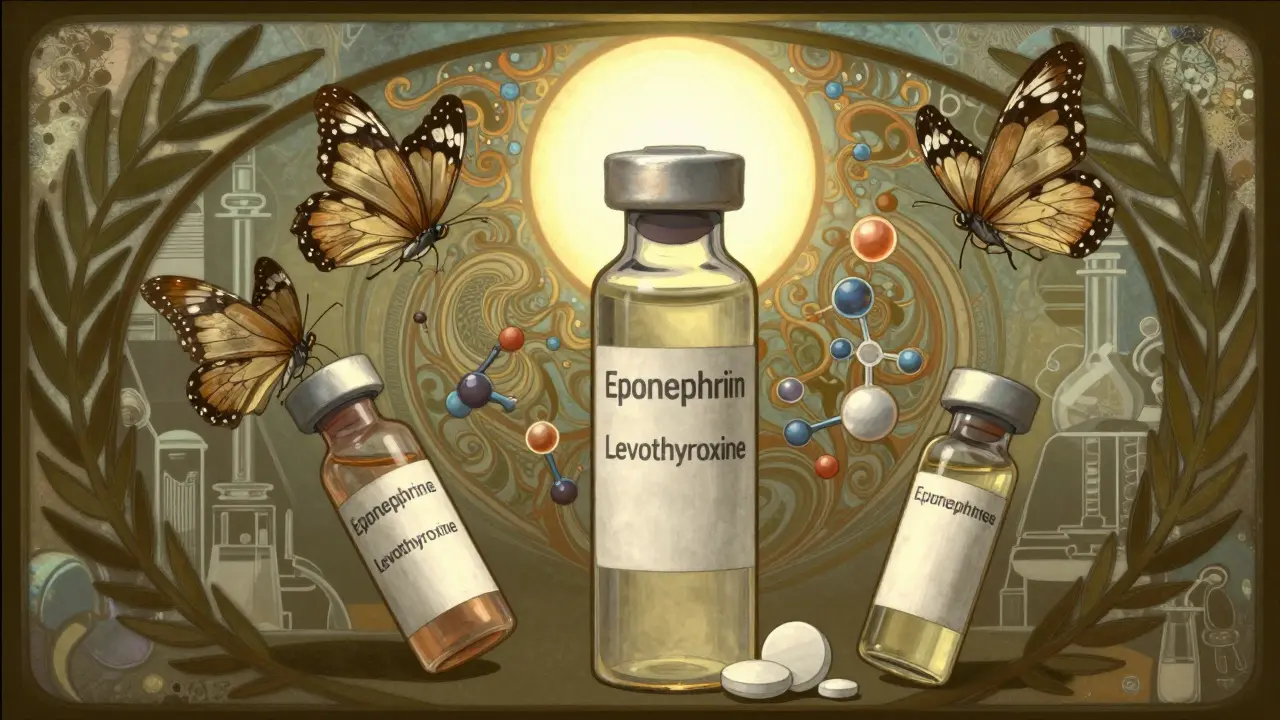
Not all medications are created equal. Some are just more fragile. A 2015 study looked at drugs stored on the ISS and found six that failed to meet potency standards before their expiration dates: amoxicillin/clavulanate, levofloxacin, trimethoprim/sulfamethoxazole, furosemide, levothyroxine, and epinephrine (EpiPen). These aren’t random picks. They’re drugs where even a small drop in strength can be dangerous.
Levothyroxine, used for thyroid conditions, needs to be exact. Too little and your metabolism slows. Too much and your heart races. EpiPens? If they don’t deliver the full dose during an allergic reaction, someone could die. That’s why these drugs have tighter controls and shorter shelf lives.
Even the same drug from different brands can behave differently. A 2017 study found that certain inactive ingredients-like hypromellose, polyethylene glycol, and polysorbate-made ibuprofen break down faster. So two 200mg ibuprofen tablets might look identical, but one could be weaker after a year simply because of what’s in the coating or filler.
Storage Is the Biggest Factor You Can Control
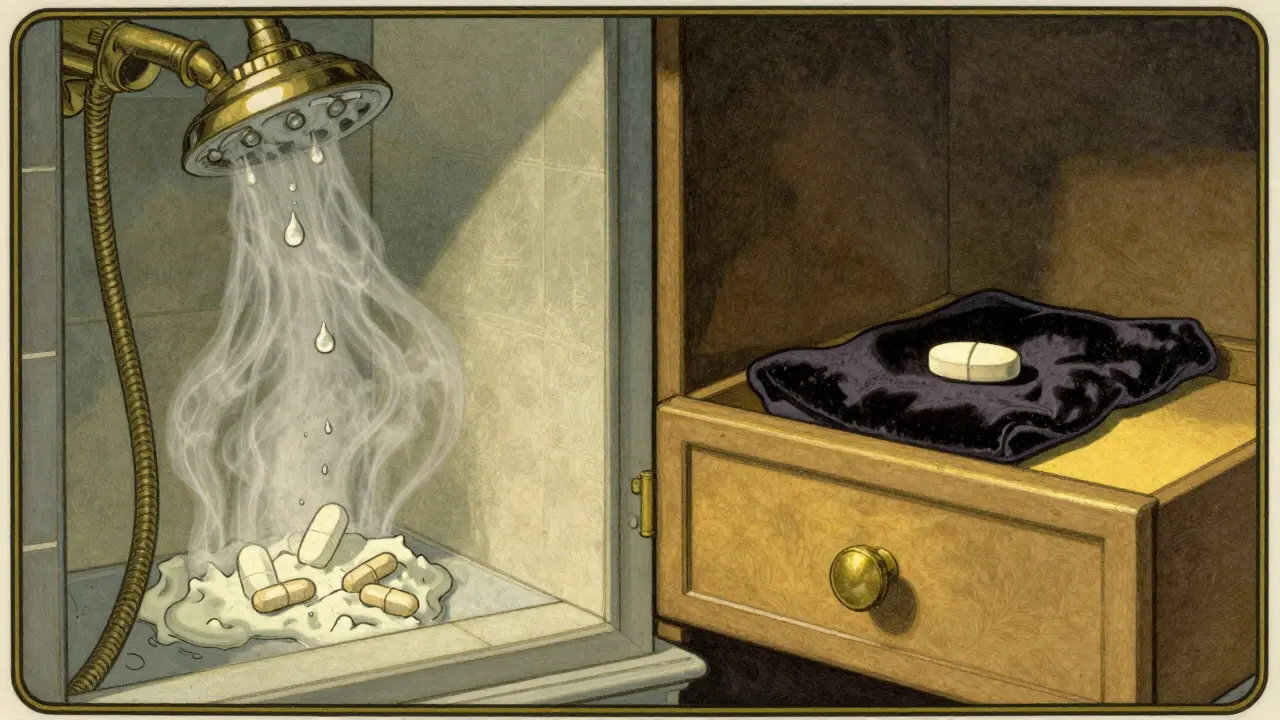
Your medicine’s lifespan depends more on where you keep it than on the expiration date. Heat, moisture, and light are the three killers. That bathroom cabinet? It’s a disaster zone. Every time you shower, humidity spikes. Temperatures swing. Studies show this can cut a drug’s shelf life by 30-50%.
Keep medications in a cool, dry place. A bedroom drawer away from windows is better than any bathroom. Avoid the kitchen, too-near the stove or dishwasher, it’s too warm. Don’t leave pills in the car. On a hot day, the inside of a car can hit 60°C. That’s like running an accelerated aging test on your medicine.
Pharmaceutical companies test this by putting drugs in ovens set to 40°C and 75% humidity for months. That simulates two years of normal storage. If the drug still passes potency tests after that, they set the expiration date. But that’s under perfect lab conditions. Your home? Not so perfect.
Expiration Dates Are Conservative-But That’s the Point
The FDA started requiring expiration dates in 1979. Before that, no one knew how long drugs lasted. Now, every manufacturer must prove through real-time and accelerated testing that their product will stay at least 90% potent until the date on the bottle. Most drugs are labeled with 1-3 years because that’s what the testing shows.
Here’s the twist: the military’s Shelf Life Extension Program found that 88% of stockpiled drugs were still effective 15 years past their expiration date. They stored them in climate-controlled warehouses. That’s not your medicine cabinet. That’s a vault. The FDA even admits that many drugs likely stay strong longer. But they won’t say so publicly because they can’t guarantee it for every bottle in every home.
Dr. Mansoor Khan, a former FDA product quality director, put it simply: “A lot of drugs are stable for longer than the given expiration date. But there are a few that degrade quickly-and that can cause a lot of harm.”
When Expired Medication Is Dangerous (And When It’s Just Weak)
Using an expired ibuprofen tablet? Probably not dangerous. You might just need to take two instead of one. But expired antibiotics? That’s a different story. If the dose is too low, the infection doesn’t die. It adapts. That’s how antibiotic resistance starts. One study found that sub-potent antibiotics contributed to treatment failures in pneumonia and urinary tract infections.
Insulin, nitroglycerin for heart attacks, epinephrine, and seizure medications? Never use them past their expiration date. These drugs need precise dosing. A 10% drop in strength might not seem like much-but in a crisis, it could be the difference between life and death.
And don’t assume a pill still looks fine means it’s good. Degradation doesn’t always change color or smell. You can’t taste or see potency. Only a lab can tell you what’s really inside.
What’s Changing in the Future
Scientists are working on smarter packaging-materials that block moisture and oxygen better. Some new bottles even have sensors that change color if the drug inside has degraded. That’s still experimental, though.
High-tech tools like HPLC-MS can now detect degradation products at levels as low as 0.05%. That means manufacturers can spot tiny chemical changes long before the drug becomes ineffective. But these tests cost thousands of dollars per sample. No one’s testing your leftover cough syrup at home.
For now, the best advice is simple: if it’s critical, don’t risk it. If it’s not, and it’s been stored well, it might still work. But you’ll never know for sure. And that uncertainty? That’s why expiration dates exist.
What to Do With Expired Medications
Don’t flush them. Don’t toss them in the trash. Many pharmacies offer take-back programs. If yours doesn’t, mix pills with coffee grounds or cat litter, seal them in a bag, and throw them in the household trash. That makes them unappealing and harder to misuse.
For liquid medications, especially those that need refrigeration, throw them away if they’ve been expired for more than a few months. Don’t try to stretch them out. The risk isn’t worth it.
Bottom Line
Medications don’t suddenly die on their expiration date. They fade slowly, like a battery losing charge. Some fade fast. Some fade slow. Where you store them matters more than the date on the bottle. But since you can’t test your medicine at home, the only safe rule is this: when in doubt, replace it. Your health isn’t worth gambling on a guess.
Eli Kiseop 1.02.2026
I always thought expiration dates were magic kill switches. Turns out they're more like 'please don't be an idiot' warnings. My ibuprofen from 2020 still crushes headaches but I'd never risk my epinephrine on a hunch.
Also why is my bathroom a chemical warfare zone?
Brett MacDonald 1.02.2026
so like... if a pill still looks like a pill does that mean its still a pill? or is that just the placebo talking? science is weird man. we put magic rocks in our mouths and hope they dont turn into poison. the fact that we dont know for sure is kinda beautiful in a terrifying way.
Sandeep Kumar 1.02.2026
USA thinks it knows everything but even you guys cant tell if your pills work? In India we just take what we have and pray. If you die its karma. If you live its divine intervention. No expiration date needed when you trust the universe.
Gary Mitts 1.02.2026
so you're telling me my 3 year old amoxicillin is basically a sugar pill with a side of false confidence?
cool. thanks for the update.
Dan Pearson 1.02.2026
Oh wow so the FDA is just playing it safe? I knew it. They're scared of lawsuits so they make us all throw out perfectly good medicine. Meanwhile China and Russia are storing their meds for decades and laughing at our overpriced pharmacy bills. This is why America is falling behind. We're too scared to be efficient.
Ellie Norris 1.02.2026
i once kept my insulin in the glovebox of my car for a week because i was in a rush. it was fine. i think. i mean i didn't die. but now i keep it in the back of my closet like a good little citizen. also the bathroom thing? yes. i used to store my thyroid meds there. bad move. like leaving a chocolate bar in a sauna.
Marc Durocher 1.02.2026
i used to think expired meds were just lazy capitalism. turns out they're just... chemistry. who knew? i mean we all know water turns to ice and fire burns things. but pills? they just... fade. like a song you forgot the lyrics to. kinda sad. but also kind of beautiful in a 'life is temporary' way.
also never store meds in your car. i learned that the hard way. melted ibuprofen is not a vibe.
larry keenan 1.02.2026
The degradation kinetics of pharmaceutical formulations are governed by first-order reaction pathways primarily influenced by environmental stressors such as relative humidity, thermal activation energy, and photochemical excitation. Accelerated stability testing under ICH Q1A guidelines provides empirical data to extrapolate shelf-life parameters, yet real-world storage conditions introduce significant variance in degradation rates. Consequently, while the 90% potency threshold remains a regulatory benchmark, the actual pharmacodynamic efficacy of certain compounds may persist beyond labeled expiration dates under controlled storage conditions.
Nick Flake 1.02.2026
I just realized my meds are like my ex - they start strong, slowly fall apart, and you never really know if they're still working until it's too late 😔💊
Also I just threw out my last EpiPen because it expired last month. I'm not risking my life on a 7-year-old plastic thing. I love life too much for that. 🙏
Akhona Myeki 1.02.2026
In South Africa we have no choice but to use expired medication. Hospitals run out. Pharmacies are closed. People die because they can't afford replacements. You talk about safety buffers. We talk about survival. Your luxury of doubt is a privilege. I don't have the luxury of replacing my blood pressure pills. I take them. Even if they're 5 years old. Because I have to.
Chinmoy Kumar 1.02.2026
i never thought about how the filler in pills could make them go bad faster. like its not just the medicine its the whole package. kinda like how a good friend can be ruined by bad habits. i think i need to check where i store my stuff now. maybe its not the date its the drawer.
also i once left my asthma inhaler in my backpack in the sun. it still worked. but i dont do that anymore. better safe than sorry.
clarissa sulio 1.02.2026
I don't care what the science says. If it's expired, I'm not taking it. I've seen people get sick from old meds. It's not worth it. Period.
Bridget Molokomme 1.02.2026
so let me get this straight... the military has a whole program to keep meds alive for 15 years but we're supposed to toss ours after 2? and you're telling me the difference is just... storage? not politics? not greed? just... a cool room?
that's almost poetic. in a 'we're all just lab rats with credit cards' kind of way.