

When someone with celiac disease eats bread, pasta, or even a sip of beer, their immune system doesn’t just react-it attacks. Not the gluten itself, but their own small intestine. This isn’t a food allergy. It’s not a digestive quirk. It’s an autoimmune response, and it’s happening in about 1 in 100 people worldwide. Yet, most still don’t know they have it. The average time to diagnosis? Over six years. And for many, symptoms don’t disappear just because they cut out gluten-they just get better. But why? And what’s really going on inside the body?
How Gluten Turns Into an Enemy Inside Your Body
Gluten isn’t poison to everyone. For most people, it passes through the gut without a trace. But if you carry the HLA-DQ2 or HLA-DQ8 gene (which about 30% of people do), gluten becomes a trigger. The problem starts with a fragment of gluten called the 33-mer gliadin. This piece is tough-it doesn’t break down easily in digestion. It slips through the gut lining, not by accident, but because gluten activates a protein called zonulin. Zonulin opens the tight junctions between gut cells like a zipper being pulled apart. Once past the barrier, the gluten fragments land in the layer beneath the lining, called the lamina propria. Here, an enzyme called tissue transglutaminase 2 (TG2) steps in. It changes the shape of gluten by swapping out certain amino acids, turning them into sticky, negatively charged bits. These altered fragments are like keys that fit perfectly into the locks of HLA-DQ2 or HLA-DQ8 molecules on immune cells. When they lock in, they wake up T-cells. These T-cells don’t just sit there-they scream. They release interferon-gamma and interleukin-21, chemicals that tell the immune system to go to war. And the target? The very lining of the small intestine. This isn’t inflammation you can see. It’s destruction at the microscopic level. The finger-like projections called villi, which absorb nutrients, start to flatten. The crypts between them grow deeper. Immune cells pile up in the lining. This is what doctors call villous atrophy. It’s why people with untreated celiac disease lose weight, get anemic, or develop osteoporosis. Their body can’t absorb iron, calcium, or vitamin D because the surface area to absorb them is gone.The Big Shift: Your Gut Lining Isn’t Just a Wall-It’s an Instigator
For decades, scientists thought the gut lining was just a passive barrier. A gatekeeper. A wall that let gluten through by mistake. But in August 2024, researchers at McMaster University flipped that idea. They found that the gut lining itself can start the attack. In people with celiac disease, some cells in the intestinal lining start producing MHC class II molecules-proteins normally only found on immune cells. These molecules can grab gluten fragments and present them directly to T-cells. In other words, your gut cells aren’t just letting the problem in-they’re helping to sound the alarm. This changes everything. It means the disease isn’t just about immune cells going rogue. It’s about the gut lining becoming part of the problem. That’s why some people develop celiac disease even after years of eating gluten without symptoms. The trigger isn’t just gluten-it’s a change in how the gut responds to it.Celiac Disease vs. Non-Celiac Gluten Sensitivity: The Key Difference
Not everyone who feels better on a gluten-free diet has celiac disease. Many say they have “non-celiac gluten sensitivity” (NCGS). But here’s the catch: NCGS doesn’t have a lab test. No antibodies. No biopsy damage. No genetic markers. It’s a diagnosis of exclusion. Celiac disease? It’s clear-cut. Blood tests show anti-tTG antibodies with 98% accuracy when the person is still eating gluten. A biopsy confirms villous atrophy. And if you carry HLA-DQ2 or HLA-DQ8, your risk jumps from 1% to 30%. NCGS? You might feel bloated, tired, or foggy after eating gluten, but your blood work is normal. Your intestine looks fine. And some people with NCGS can handle small amounts of gluten without trouble. The numbers tell the story. About 1% of the global population has celiac disease. NCGS? Estimates range from 0.5% to 13%. That wide range? It’s because we’re still figuring out what NCGS even is. Maybe it’s wheat proteins other than gluten. Maybe it’s FODMAPs. Maybe it’s a mix. But for celiac, the trigger is gluten, the mechanism is autoimmune, and the damage is measurable.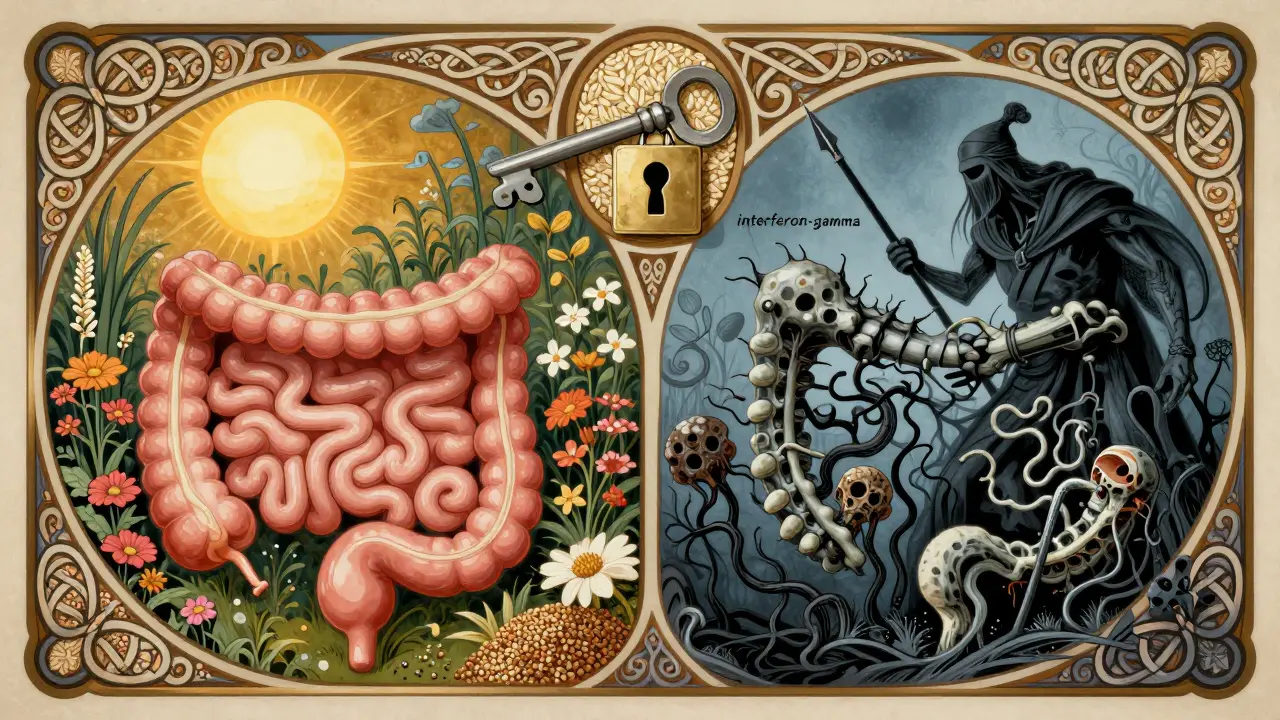
Why a Gluten-Free Diet Isn’t Just a Trend-It’s a Lifesaving Rule
There’s no pill. No vaccine. No cure. The only proven treatment for celiac disease is a strict, lifelong gluten-free diet. And “strict” means less than 20 parts per million (ppm) of gluten. That’s not “mostly gluten-free.” That’s not “I don’t eat bread.” That’s no cross-contamination. No shared toasters. No unmarked sauces. No hidden malt in soy sauce or modified food starch in processed meats. The science backs this. Studies show that even 50 milligrams of gluten a day-about the size of a crouton-can keep the immune system active and prevent healing. That’s why 30% of diagnosed people still have symptoms, even after years on the diet. It’s not that the diet doesn’t work. It’s that most people aren’t getting it right. The first step? Clean out your kitchen. Replace cutting boards, toasters, colanders, and utensils. Gluten sticks. It lingers. A single crumb in a toaster can contaminate an entire slice of gluten-free bread. Use separate condiment jars. Label everything. The average cost to start fresh? $350-$500. It’s not cheap. But it’s cheaper than the long-term damage.What You Can Eat-and What You Can’t
Gluten hides in places you wouldn’t guess. Barley, rye, wheat-obvious. But malt flavoring? Hydrolyzed vegetable protein? Modified food starch? These can all come from wheat. So can soy sauce, imitation crab, some medications, and even lipstick. Safe grains? Rice, corn, quinoa, buckwheat, millet, amaranth, teff, and certified gluten-free oats. But even oats can be contaminated unless labeled gluten-free. Always check. Look for the “gluten-free” label. In the U.S., that means less than 20 ppm. In Europe, same rule. In Australia? Also 20 ppm. It’s a global standard. Fruits, vegetables, meats, fish, eggs, dairy, nuts, beans, legumes, and oils are naturally gluten-free. But processed versions? Read the label. If it says “natural flavors” or “starch,” dig deeper. Call the company. Use apps like Find Me Gluten Free. They’re rated 4.7 stars by over 185,000 users.Why Healing Takes Time-And Why Some Never Fully Recover
After diagnosis, most people feel better within weeks. Bloating fades. Energy returns. But healing the gut? That takes months to years. For children, the lining can recover in 6-12 months. For adults? Often 2-5 years. And not everyone heals completely. A 2023 survey of 15,328 people with celiac disease found that 89% saw major improvement within six months. But 42% still had occasional symptoms. Why? Cross-contamination. Medications. Hidden gluten in supplements. Even hand soap or play-dough can be a source. Nutrient deficiencies are common. Iron deficiency? Affects 33%. Vitamin D? 47%. Calcium? 38%. Zinc? 25%. That’s why follow-up blood tests are critical-not just to check antibodies, but to monitor nutrient levels. Many people need supplements for years, even on a perfect diet.
What’s Coming Next: Beyond the Gluten-Free Diet
The gluten-free diet works. But it’s hard. And it’s not perfect. That’s why researchers are racing to find alternatives. Three therapies are in late-stage trials:- Nexvax2: A vaccine-like therapy that trains the immune system to ignore gluten. Phase 2 trials in late 2023 showed a 42% drop in symptoms.
- Latiglutenase: An enzyme that breaks down gluten in the stomach before it reaches the intestine. In a 2022 trial, 37% of users had fewer symptoms.
- TAK-101: A nanoparticle therapy that teaches the immune system to tolerate gluten. A 2023 study found a 63% reduction in intestinal damage.
Real Stories: What Living With Celiac Really Looks Like
One Reddit user, ‘GlutenFreeSince2010,’ spent seven years and saw four doctors before getting diagnosed. Symptoms started at 28. By the time they got the biopsy, they were nearly anemic. After going gluten-free, their energy returned. But they still avoid restaurants unless they call ahead. Another, ‘CeliacWarrior87,’ had a follow-up endoscopy in January 2024. Their gut was healed. But they said: “Maintaining <20 ppm gluten requires constant vigilance.” That’s the reality. It’s not a diet. It’s a lifestyle. And it’s exhausting. A 2023 survey found that 63% of young adults with celiac avoid social events because of food. 58% said it hurt their mental health. The cost? Gluten-free products cost 242% more than regular ones. And only 12% of U.S. health plans cover them.What You Need to Know Right Now
- If you suspect celiac disease, do not cut gluten before testing. You need to be eating gluten for blood tests and biopsies to be accurate.
- Genetic testing for HLA-DQ2/DQ8 can rule out celiac disease with 99% accuracy-if negative, you don’t have it.
- Anti-tTG antibodies are the gold standard for diagnosis-98% sensitive, 95% specific.
- Always choose certified gluten-free products. “Gluten-free” on the label means less than 20 ppm.
- Medications and supplements aren’t required to list gluten. Call manufacturers.
- Healing takes time. Be patient. Track your symptoms. Get blood work done yearly.
Can you outgrow celiac disease?
No. Celiac disease is a lifelong genetic condition. Once diagnosed, you must avoid gluten for life. Unlike food allergies, which some children outgrow, celiac disease involves permanent immune system changes and intestinal damage that only heals with strict gluten avoidance. There are no known cases of spontaneous recovery.
Is a gluten-free diet healthy for people without celiac disease?
Not necessarily. Many gluten-free products are lower in fiber, iron, and B vitamins because they’re made with refined rice or potato starch instead of whole wheat. Unless you have celiac disease, non-celiac gluten sensitivity, or a wheat allergy, there’s no proven health benefit to avoiding gluten. In fact, cutting out whole grains without replacement can lead to nutrient gaps. A gluten-free diet should be medically guided, not trendy.
Can you test for celiac disease at home?
Home antibody tests exist, but they’re not reliable for diagnosis. They can give false negatives if you’ve already cut gluten, or false positives due to other conditions. A proper diagnosis requires blood tests (tTG-IgA) followed by a biopsy of the small intestine, both done under medical supervision. Never self-diagnose.
Why do some people with celiac disease still have symptoms after going gluten-free?
The most common reason is accidental gluten exposure-cross-contamination in kitchens, restaurants, or from medications. Other causes include other conditions like IBS, lactose intolerance (common after celiac diagnosis), or refractory celiac disease (a rare complication where the gut doesn’t heal). If symptoms persist, a follow-up endoscopy and nutrient panel are needed to find the cause.
Are oats safe for people with celiac disease?
Pure, uncontaminated oats are generally safe for most people with celiac disease. But most oats are processed in facilities that also handle wheat, barley, or rye. Only choose oats labeled “certified gluten-free.” Even then, a small percentage of people react to avenin, a protein in oats similar to gluten. If you’re unsure, introduce oats slowly under medical guidance.
Lebogang kekana 3.03.2026
This is the most accurate breakdown of celiac I've ever read. Seriously. I thought I was just 'sensitive' until I saw the part about zonulin and villous atrophy. My gut has been screaming for years, and now I know why. I'm getting tested tomorrow. Thank you.
Deborah Dennis 3.03.2026
Ugh. Another ‘gluten is evil’ post. Look, I’ve been gluten-free for 12 years… and I still eat sourdough. And pizza. And beer. My doctor says I’m fine. You people are just scared of carbs. And also, ‘cross-contamination’? That’s a myth. A. Myth.
Jessica Chaloux 3.03.2026
I cried reading this. 😭 I was misdiagnosed for 8 years. I thought I had IBS. Then I found out I had villous atrophy. My mom still doesn’t believe me. She says, 'You're just being dramatic.' But now? I'm healed. Mostly. And I finally have energy. 🙏
Raman Kapri 3.03.2026
The assertion that non-celiac gluten sensitivity lacks biological markers is misleading. A 2021 double-blind placebo-controlled study in The Lancet Gastroenterology demonstrated IgG-mediated immune responses in a subset of NCGS patients. Furthermore, the claim that gluten-free diets are universally lifesaving ignores the rising prevalence of orthorexia and nutritional deficiencies in populations adopting restrictive diets without medical supervision.
Megan Nayak 3.03.2026
So let me get this straight. The gut lining becomes an accomplice in its own destruction? How poetic. How tragic. We are not just victims of gluten-we are victims of our own biology turning against us. And yet, society tells us to 'just eat better.' Meanwhile, the pharmaceutical industry is quietly funding 'gluten vaccines' because they know: the real money isn't in healing-it's in managing the disease forever.
Tildi Fletes 3.03.2026
A critical clarification: The 20 ppm gluten-free standard is enforced by the FDA in the United States and codified under 21 CFR 101.91. However, in the European Union, the threshold for 'gluten-free' is also 20 ppm, but for 'very low gluten' it is 100 ppm. Furthermore, oats must be certified gluten-free due to cross-contamination during farming and processing-not because oats contain gluten. Always verify certification logos: GFCO, Coeliac UK, or CIC. Supplement labels require scrutiny-many contain wheat-derived dextrose or maltodextrin. Consult a registered dietitian specializing in celiac disease for personalized guidance.
RacRac Rachel 3.03.2026
I'm so glad this exists. 🌟 I was diagnosed at 34 after years of fatigue, brain fog, and random rashes. My kitchen is now a gluten-free zone. I replaced everything. Even my wooden spoons. And yes-it cost $450. But I can finally hug my kids without worrying I'll make them sick. I still have bad days. But now I know why. And I’m not alone. You got this. 💪❤️
Levi Viloria 3.03.2026
I live in India. We don’t eat much bread here. But when I tried gluten-free pasta last year? My stomach didn’t explode. I thought I had celiac. Got tested. Negative. Turns out, I just hate the texture of gluten-free noodles. And honestly? I’m okay with that. Not everyone needs to be a warrior. Sometimes, it’s just… food.