
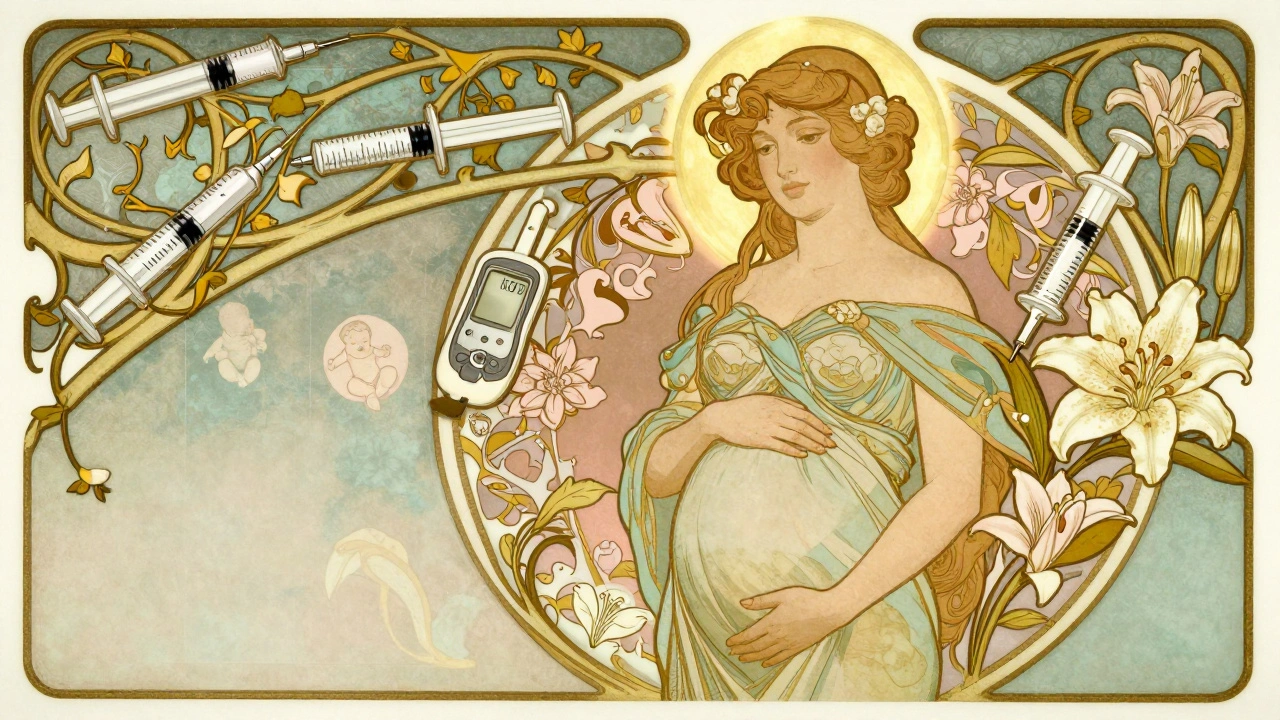
Managing diabetes during pregnancy isn’t just about keeping blood sugar in check-it’s about protecting two lives. Whether you’re living with type 1, type 2, or have been diagnosed with gestational diabetes, the choices you make around medication matter. The stakes are high: uncontrolled blood sugar increases risks of preterm birth, preeclampsia, large babies, and neonatal hypoglycemia. But the good news? With the right plan, most women have healthy pregnancies and healthy babies.
Insulin: The Gold Standard for Pregnancy
Insulin is still the most trusted and widely used medication for diabetes during pregnancy. Why? Because it doesn’t cross the placenta. That means it doesn’t reach the baby directly. This makes it the safest option when diet and exercise alone aren’t enough to hit target glucose levels.
The Endocrine Society’s 2023 guidelines recommend rapid-acting insulin analogs-like insulin lispro and insulin aspart-as first-line choices for mealtime control. These work faster and more predictably than regular human insulin, giving better post-meal spikes without raising your risk of low blood sugar. For background coverage, insulin detemir and NPH are both well-studied and considered safe. Insulin glargine is also used, with data from over 700 pregnant women showing outcomes similar to NPH.
But not all insulins are cleared for pregnancy. Insulin glulisine and degludec don’t have enough safety data yet, so they’re not recommended. If you’re on one of these before pregnancy, you’ll need to switch before conceiving.
Many women use insulin pumps (continuous subcutaneous insulin infusion, or CSII) during pregnancy. Studies show they can lead to slightly lower HbA1c levels and less insulin needed at delivery. But the big picture? Birth outcomes are just as good as with multiple daily injections. The real benefit? More flexibility. If you’re nauseous in the first trimester or your appetite changes in the third, the pump lets you adjust doses quickly without switching needles.
Oral Medications: Metformin and the Gray Zone
Metformin is the only oral medication with enough data to be considered for use in pregnancy-mostly for gestational diabetes and some cases of type 2 diabetes. It’s not a first-line choice everywhere, but it’s used often because it’s cheap, easy to take, and has some real benefits.
A major 2019 NIH analysis found that women taking metformin had lower rates of large-for-gestational-age babies, fewer NICU admissions, and less preeclampsia compared to those on insulin. It also caused less weight gain. For some women, that’s a huge win.
But here’s the catch: about half of women on metformin end up needing insulin anyway. Their blood sugar just doesn’t stay under control as pregnancy progresses. And while metformin crosses the placenta, long-term studies on children exposed to it in utero are still ongoing. Some research suggests it might affect metabolic pathways like mTOR, which could influence how the baby’s body regulates energy later in life. We don’t know the full impact yet.
The Endocrine Society says metformin can be used for gestational diabetes, but it advises against adding it to insulin for women with preexisting type 2 diabetes. Why? Because it might increase the chance of having a small baby without enough benefit to balance the risk. The Joslin Diabetes Center takes an even stricter view: they say metformin shouldn’t be used beyond the first trimester and shouldn’t replace insulin.
So if you’re considering metformin, talk to your doctor about your goals. If you’re worried about insulin injections, metformin might help you delay them. But if your blood sugar is already high, insulin might be the faster, safer route.
What About Other Oral Drugs?
Many diabetes pills you’ve heard of-like GLP-1 receptor agonists (semaglutide, liraglutide), SGLT2 inhibitors (dapagliflozin, empagliflozin), DPP-4 inhibitors (sitagliptin), and alpha-glucosidase inhibitors (acarbose)-are off-limits during pregnancy.
GLP-1RAs are especially tricky. They’re great for weight loss and blood sugar control, but animal studies show potential risks to fetal development. The Endocrine Society now says to stop them before conception, not just during early pregnancy. If you’re on one and thinking about getting pregnant, plan ahead. It can take weeks or months to clear these drugs from your system.
SGLT2 inhibitors are linked to fetal malformations in animal models and can cause dehydration and low blood pressure in pregnant women. DPP-4 inhibitors and acarbose? Simply not studied enough. No one knows if they’re safe. So they’re not used.
This leaves a big gap. For women who can’t or won’t use insulin, and who aren’t candidates for metformin, options are extremely limited. That’s why preconception planning is so critical.

What You Need to Do Before Getting Pregnant
If you have type 1 or type 2 diabetes and are thinking about pregnancy, don’t wait until you miss your period. Start planning at least 3-6 months ahead.
- Get your HbA1c below 6.5%-ideally closer to 6%. Higher levels increase the risk of birth defects, especially in the first 8 weeks when organs are forming.
- Stop unsafe medications. If you’re on a GLP-1RA, SGLT2 inhibitor, or other unapproved drug, switch to insulin under your doctor’s guidance.
- Start folic acid. Take at least 5 mg daily before conception and through the first trimester. This reduces neural tube defect risk by up to 70% in diabetic pregnancies.
- Check your eyes and kidneys. Diabetic retinopathy and nephropathy can worsen during pregnancy. Get screened before you conceive.
- Use contraception if your HbA1c is above 10%. High blood sugar at conception is dangerous. Your doctor may strongly recommend long-acting reversible contraceptives (like IUDs or implants) until your diabetes is under control.
Target Blood Sugar Levels During Pregnancy
Normal blood sugar ranges change during pregnancy. The goals are tighter than for non-pregnant adults.
- Fasting: Under 95 mg/dL (5.3 mmol/L)
- 1 hour after meals: Under 140 mg/dL (7.8 mmol/L)
- 2 hours after meals: Under 120 mg/dL (6.7 mmol/L)
These targets come from the Endocrine Society and ACOG. Hitting them reduces the risk of complications by up to 50%. Most women need to test their blood sugar 4-7 times a day: fasting, before meals, and 1-2 hours after eating.
Continuous glucose monitors (CGMs) are becoming more common, especially for women with type 1 diabetes. They give real-time trends and alerts for highs and lows. While they’re proven to improve outcomes in type 1 pregnancies, evidence for type 2 is still emerging. Still, many doctors now recommend them if you’re on insulin.
What Happens During Labor and Delivery?
During labor, your body goes through massive stress. Blood sugar can swing wildly-sometimes high, sometimes dangerously low. That’s why you’ll be monitored closely.
Most hospitals check your blood sugar every hour during labor. If it goes above 110 mg/dL, you’ll likely get an IV insulin drip to keep it stable. You won’t be given oral meds or insulin injections during labor-it’s too unpredictable. IV insulin gives precise control.
After delivery, your insulin needs drop fast. Many women with gestational diabetes stop all meds right away. Those with type 1 or type 2 will need to adjust doses, often going back to their pre-pregnancy levels within days.
What About Breastfeeding?
Good news: most diabetes medications are safe while breastfeeding.
Insulin is perfectly safe-it doesn’t pass into breast milk. Metformin passes in tiny amounts, but studies show no harmful effects on babies. In fact, breastfeeding can help lower your blood sugar and reduce your insulin needs.
GLP-1RAs and SGLT2 inhibitors? Not recommended while nursing. There’s no data on their safety in breast milk. Stick to insulin or metformin if you’re feeding your baby.
Final Thoughts: Safety, Not Perfection
There’s no perfect medication for diabetes in pregnancy. Insulin works. Metformin helps some. Everything else is too risky. The goal isn’t to avoid meds-it’s to use the right ones at the right time.
If you’re planning a pregnancy, start early. Get your numbers under control. Talk to your endocrinologist and obstetrician together. Don’t be afraid to ask questions about your options. And remember: you’re not alone. Thousands of women manage diabetes through pregnancy every year-and go on to raise healthy kids.
What matters most isn’t whether you need insulin or metformin. It’s that you’re taking steps to protect your baby’s future-and your own health.
Allan maniero 1.12.2025
Man, I remember when I was helping my sister navigate her gestational diabetes last year. She was terrified of needles, honestly. The idea of insulin made her cry. But after talking to her endo, she switched from metformin to lispro and detemir, and it was like night and day. No more 3 a.m. panic checks. She even started using a CGM and said it felt like having a co-pilot. Turns out, the fear of shots was way worse than the actual shots. Now she’s got a 6-month-old who’s perfectly healthy, and she swears by the insulin route. Just wish more docs talked about the emotional side of this stuff, not just the numbers.
Anthony Breakspear 1.12.2025
Insulin ain’t scary-it’s just medicine with a side of dignity. Metformin? Sure, it’s the budget option, but let’s be real: if your blood sugar’s doing the cha-cha during pregnancy, you don’t want to be dancing with a drug that’s still got a ‘may cause fetal mTOR chaos’ footnote. I’ve seen moms try to ‘go natural’ with metformin and end up in the NICU because their baby was the size of a watermelon. Insulin doesn’t play games. It shows up, does the job, and leaves the baby alone. Period.
Zoe Bray 1.12.2025
Per the Endocrine Society Clinical Practice Guidelines (2023), insulin analogs-specifically rapid-acting lispro and aspart, along with basal detemir and NPH-are classified as Category A agents for gestational and pre-gestational diabetes management. Metformin, while exhibiting placental transfer and potential epigenetic modulation via mTOR pathways, remains a Category B agent with limited long-term pediatric outcome data. GLP-1RAs and SGLT2 inhibitors remain contraindicated due to teratogenic risk profiles in preclinical models. Preconception HbA1c optimization below 6.5% is associated with a 58% reduction in congenital anomaly incidence. CGM utilization in Type 1 pregnancies demonstrates statistically significant improvements in time-in-range (TIR) and reduction in hypoglycemic events. IV insulin infusion during labor remains the standard of care for glycemic control due to pharmacokinetic unpredictability of subcutaneous administration.
Girish Padia 1.12.2025
Why do people even consider metformin? It's a diabetes pill for lazy people who don't want to inject. But your baby ain't a test subject. If you can't handle insulin, maybe you shouldn't be pregnant. I've seen too many kids with metabolic issues later because mom took metformin thinking it was 'natural.' It's not. It's a chemical. And your kid pays the price.
Saurabh Tiwari 1.12.2025
insulin for the win 🤝 but also metformin helped my cousin a lot, she was so scared of needles 😅 maybe the real answer is not 'which drug' but 'who's listening to you' 🤔
Michael Campbell 1.12.2025
Big Pharma pushed insulin because it’s profitable. Metformin’s cheaper, safer, and works fine. Why are doctors ignoring that? They’re scared of lawsuits, not science. And don’t get me started on CGMs-those are just surveillance tools for insurance companies to punish you if your numbers aren’t perfect.
Victoria Graci 1.12.2025
It’s funny how we treat pregnancy like a medical emergency that needs to be controlled, rather than a natural process that medicine can support. Insulin is a tool, not a moral victory. Metformin isn’t a compromise-it’s a different kind of care. We’re so obsessed with perfect numbers that we forget the person behind the glucose monitor. What if the real goal isn’t to control the baby’s environment, but to honor the mother’s autonomy in choosing how to protect it? Maybe the answer isn’t in the drug… but in the relationship between patient and provider.
Saravanan Sathyanandha 1.12.2025
In India, many women with gestational diabetes are prescribed metformin because insulin is expensive and hard to access. But I’ve seen families travel hours just to get insulin pens-because they know the risks. The truth is, no medication is perfect, but safety should never be a luxury. We need better healthcare equity, not just better guidelines. And yes, breastfeeding with metformin? My aunt did it for a year-baby turned out brilliant, no issues. Data matters, but lived experience matters too.
alaa ismail 1.12.2025
Honestly, I was on metformin for my gestational diabetes and switched to insulin at 28 weeks. Didn’t even notice the difference. The pump was weird at first, but now I don’t know how I lived without it. My baby’s 8 months old and loves bananas. Zero issues. Just do what your doc says and don’t stress. You’re doing better than you think.
ruiqing Jane 1.12.2025
Let me be clear: if you’re pregnant and diabetic, insulin isn’t optional-it’s non-negotiable. Metformin is a Band-Aid on a bullet wound. Your baby’s brain is developing right now. Don’t gamble with unproven drugs because you hate needles. This isn’t about convenience. It’s about survival. And if you’re not ready to do what’s necessary, you shouldn’t be pregnant. I mean that. No sugarcoating.
Fern Marder 1.12.2025
Metformin users are basically playing Russian roulette with their baby’s future 😬 Insulin is the only responsible choice. If you’re not using it, you’re just delaying the inevitable. And CGMs? If you can’t afford one, you’re not trying hard enough. This isn’t 2005 anymore.
Saket Modi 1.12.2025
why do i even read this? everyone just wants to sell you insulin or a pump. just eat less sugar and chill. problem solved. 🤷♂️
Chris Wallace 1.12.2025
I’ve been a type 1 diabetic for 22 years. Had two kids with insulin pumps. The first time I saw my daughter’s CGM graph during labor-her glucose staying between 85 and 95 for 12 hours straight-it hit me: this is science, not magic. It’s not about being perfect. It’s about consistency. The real win isn’t the insulin. It’s the team-your endo, your OB, your partner, your doula. They’re the ones holding you up when your body feels like it’s betraying you. Don’t forget that.
william tao 1.12.2025
It’s alarming how lax the medical community has become. The Endocrine Society’s recommendations are not guidelines-they’re mandates. Yet we allow metformin to be prescribed as a first-line agent in many clinics. This is not evidence-based medicine; it’s cost-driven negligence. And the fact that CGMs are still considered ‘optional’ for type 2 pregnancies? Unacceptable. We are failing mothers and infants by prioritizing budget over biology.
John Webber 1.12.2025
my doc said insulin but i took metformin anyway. baby is fine. you guys are overreacting. lol