
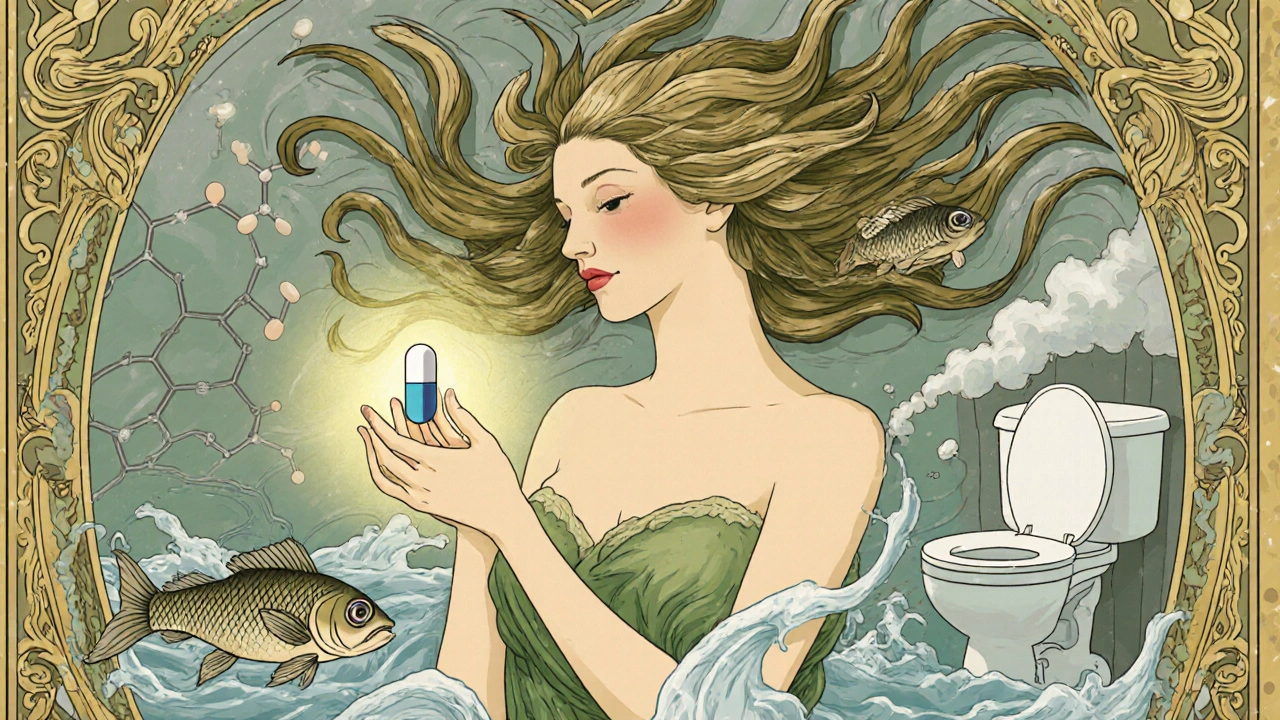
Every year, millions of unused or expired medications end up in toilets and sinks. People do it because it seems easy, clean, or even safe-especially if they’ve heard old advice to flush opioids to prevent abuse. But here’s the truth: flushing medications is one of the worst things you can do for your local waterways, fish, and even your own drinking water.
It’s not just about what you see in the toilet. It’s about what doesn’t disappear. Pharmaceuticals don’t vanish when they go down the drain. They travel through sewer systems, pass through wastewater treatment plants, and end up in rivers, lakes, and groundwater. These aren’t just traces. They’re active chemicals-antibiotics, antidepressants, painkillers, hormones-that are designed to change how your body works. And now, they’re changing how nature works too.
How Medications End Up in Water
The main source of pharmaceutical pollution isn’t flushing. It’s your body. When you take a pill, only 20-30% of the active ingredient gets absorbed. The rest gets excreted-through urine or feces-and flows into sewage systems. That’s the biggest contributor.
But flushing adds a direct, fast, and avoidable hit. When you toss a bottle of ibuprofen or a patch of fentanyl down the toilet, you’re bypassing all natural filters. These chemicals enter waterways immediately. In landfills, pills in the trash slowly break down and leak into soil and groundwater through leachate. One study found acetaminophen concentrations in landfill runoff as high as 117,000 nanograms per liter-over a thousand times higher than levels found in treated drinking water.
Wastewater plants weren’t built to remove drugs. They handle solids, bacteria, and nutrients. They’re not equipped to catch tiny, complex molecules like diclofenac, carbamazepine, or estrogen from birth control pills. Even advanced treatment methods like ozone or activated carbon can remove 85-95% of these compounds-but only a handful of cities in the U.S. have them. Most plants let them pass right through.
What Happens to Fish and Wildlife
It’s not science fiction. Fish are changing. In rivers downstream from wastewater outflows, male fish are growing eggs. Scientists have documented intersex fish in over 80% of tested U.S. waterways. The culprit? Estrogen-like compounds from birth control pills and hormone replacement therapies. These chemicals mimic natural hormones, tricking fish into developing female characteristics-even when they’re genetically male.
Antibiotics in water are making bacteria stronger. We’re seeing more antibiotic-resistant strains in rivers and lakes. That’s not just an environmental issue-it’s a public health crisis. If the bacteria that cause infections in humans become resistant because of environmental exposure, our medicines stop working faster.
And it doesn’t stop at fish. Aquatic plants absorb these compounds. Small organisms eat the plants. Bigger fish eat those organisms. The drugs don’t break down-they concentrate as they move up the food chain. That’s called biomagnification. A study from the Brazos River Authority found that fish near wastewater outflows had measurable levels of antidepressants in their tissues. What happens when people eat those fish? We don’t fully know yet. But we know enough to be worried.
The FDA’s ‘Flush List’-What’s Safe to Flush?
The FDA once told people to flush certain drugs to prevent accidental overdose or abuse. That list included powerful opioids like fentanyl patches and oxycodone tablets. The logic was simple: if a child or pet finds these pills, they could die. Flushing was seen as the fastest way to remove the danger.
But in October 2022, the FDA updated that list. Only 15 medications remain on it-mostly high-risk opioids. Everything else? Don’t flush it. The agency now says the environmental risk from flushing these few drugs is negligible compared to the risk of misuse. But here’s the problem: most people don’t know the list exists, let alone what’s on it. And even if you do, you might not know which pills on your shelf are on the list. A 2021 FDA survey found only 30% of Americans could identify a safe disposal option.
What You Should Do Instead
There are three real options for safe disposal-and one you should never use.
- Take-back programs-These are the gold standard. Pharmacies, hospitals, and police stations often host collection bins. Some even offer mail-back envelopes. The drugs are incinerated under controlled conditions, destroying the chemicals completely. In Australia, pharmacies like Chemist Warehouse and Priceline offer free take-back services. In the U.S., the DEA runs National Prescription Drug Take Back Days twice a year, plus permanent drop-off locations in 2,140 sites nationwide. But access is uneven. Only 15% of U.S. counties have permanent sites. If you’re in Perth, check with your local council or pharmacy-many now have bins in-store.
- Home disposal with mixing-If no take-back is available, mix pills with something unappetizing: used coffee grounds, cat litter, or dirt. Put them in a sealed container-like a jar or plastic bag-and toss them in the trash. This doesn’t destroy the drug, but it makes it unattractive to kids, pets, or people who might dig through your garbage. The EPA recommends this method as a last resort.
- Don’t flush-Unless it’s on the FDA’s current flush list, never flush anything. Not antibiotics. Not antidepressants. Not your grandma’s old blood pressure pills. Even if the bottle says “dispose of properly,” it doesn’t mean “flush.”
And don’t pour liquids down the sink. Liquid medications can seep through pipes and soil just as easily as solids. Same rule applies.
Why Take-Back Programs Are Still Underused
People want to do the right thing. But barriers are real.
First, access. If you live in a rural area or small town, the nearest take-back bin might be 30 minutes away. Many pharmacies don’t have the space or funding to run collection programs. Second, confusion. People mix up the FDA’s flush list. They think flushing is okay if it’s expired. Or they believe “if it’s not dangerous, it’s fine to flush.” Third, stigma. Some people feel ashamed to admit they have unused meds. They hoard them instead.
One Reddit user from Perth wrote: “I had no idea flushing meds was bad until I read about fish mutations last year. Now I drive 20 minutes to the nearest drop-off. It’s a pain, but I’d rather do that than risk poisoning the river.”
That’s the mindset we need more of.
What’s Being Done to Fix This
Change is happening-but slowly.
In Europe, 16 countries now require drug manufacturers to pay for take-back programs under Extended Producer Responsibility (EPR) laws. The idea? If companies profit from selling pills, they should pay to clean up the waste. In California, a new law (SB 212, effective January 2024) forces pharmacies to hand out disposal instructions with every prescription. Australia is testing similar models.
Wastewater treatment tech is advancing. Cities like San Francisco and Sydney are piloting ozone and granular activated carbon systems that can remove over 90% of pharmaceuticals. But these upgrades cost $500,000 to $2 million per plant. Most municipalities can’t afford them without federal help.
The most powerful tool? Prevention. Doctors are prescribing smaller quantities. Pharmacists are counseling patients on how much they really need. Some clinics now offer “medication reconciliation” services-reviewing what you’re taking to cut down on waste before it even starts.
What You Can Do Today
You don’t need a PhD to make a difference. Here’s your action list:
- Check your medicine cabinet. Remove expired or unused pills. Don’t wait for “someday.”
- Find your nearest take-back location. Use the DEA’s locator tool (U.S.) or your local council website (Australia). If you’re in Perth, try the City of Perth’s waste services page.
- If no drop-off is nearby, mix pills with coffee grounds or cat litter. Seal them. Trash them.
- Ask your pharmacist: “Do you take back unused meds?” If they say no, ask why. Pressure matters.
- Don’t stockpile. Only buy what you need. Talk to your doctor about smaller prescriptions.
- Spread the word. Tell friends. Post on social media. This isn’t just about water-it’s about protecting the food chain, your health, and future generations.
The problem won’t vanish overnight. But every pill you don’t flush is one less chemical entering a river. Every person who learns this and changes their habit? That’s a ripple that turns into a wave.
Is it ever okay to flush medications?
Only if the medication is on the FDA’s current flush list-which includes only 15 high-risk opioids like fentanyl patches and oxycodone tablets. For everything else, flushing is harmful. Most medications, including antibiotics, antidepressants, and painkillers like ibuprofen, should never be flushed. The risk of contaminating waterways far outweighs any benefit.
Why can’t wastewater plants remove drugs?
Wastewater treatment plants were designed to remove solids, bacteria, and nutrients-not tiny, complex chemical molecules like pharmaceuticals. These drugs are designed to be stable in the body, so they’re also stable in water. Standard processes like sedimentation and chlorine treatment don’t break them down. Only advanced systems like ozone or activated carbon can, but those are expensive and rare.
What happens to medications in landfills?
When pills are thrown in the trash, they sit in landfills where rainwater can seep through and carry chemicals into groundwater. Studies show high concentrations of drugs like acetaminophen and ciprofloxacin in landfill leachate. While flushing sends drugs straight to water, landfill disposal creates slow, ongoing contamination that’s harder to track and clean up.
Are take-back programs free?
Yes. Most take-back programs at pharmacies, hospitals, or police stations are free. In Australia, major chains like Chemist Warehouse and Priceline offer free drop-off bins. In the U.S., DEA Take Back Days and permanent collection sites don’t charge fees. The cost is covered by government programs or pharmaceutical manufacturers under new regulations.
Can I just throw pills in the trash without mixing them?
It’s not recommended. Unmixed pills in the trash can be found by children, pets, or people looking for drugs to misuse. The EPA advises mixing them with something unappealing-like coffee grounds, dirt, or cat litter-and sealing them in a container before tossing. This reduces the risk of accidental ingestion or abuse.
Do expired medications lose their environmental impact?
No. Even expired medications still contain active chemicals. While potency may decrease, the molecular structure often remains intact enough to affect aquatic life. A 10-year-old bottle of ibuprofen can still disrupt fish hormones. Expiration dates relate to effectiveness in humans, not environmental safety.
What about liquid medications? Can I pour them down the drain?
No. Liquid medications-like cough syrup or eye drops-should never be poured down the sink or toilet. They dissolve quickly and enter water systems immediately. The same rules apply: use a take-back program, or mix with an absorbent material like kitty litter, seal in a container, and put in the trash.
Is this problem getting worse?
Yes. Global pharmaceutical use is rising, especially in middle-income countries. At the same time, wastewater treatment hasn’t kept pace. Studies show pharmaceutical concentrations in rivers have increased by 30-50% over the last decade. Without better disposal habits and infrastructure, this will continue. But awareness is growing-and so are solutions.
What Comes Next
Changing how we dispose of meds won’t fix everything. But it’s one of the most direct actions individuals can take. The next time you clean out your medicine cabinet, don’t just toss it. Don’t flush it. Find a drop-off. Talk to your pharmacist. Help someone else learn.
This isn’t about guilt. It’s about responsibility. The water you drink, the fish you eat, the rivers you walk beside-they’re all connected to what you flush down the toilet. And you have more power to protect them than you think.
Cynthia Boen 25.11.2025
Wow, another guilt-trip article. I flush my old pills because it’s easier than driving 20 minutes to some pharmacy that probably doesn’t even take them. And yeah, maybe the fish are weird-but they’ve been weird since the 80s. Don’t act like this is some new crisis.
Amanda Meyer 25.11.2025
While I appreciate the urgency here, the real issue is systemic. We’ve outsourced responsibility to individuals while pharmaceutical companies profit from overprescribing and avoid accountability. The FDA’s flush list is a Band-Aid. We need mandatory take-back infrastructure funded by manufacturers-not another ‘do your part’ lecture. This isn’t about laziness; it’s about design failure.
Jesús Vásquez pino 25.11.2025
Bro, I just threw my expired Zoloft in the trash last week. No mixing, no drop-off. I’m not driving across town for a pill. If the system doesn’t make it easy, don’t act like people are villains for doing what’s convenient. Also, have you seen the price of cat litter these days?
hannah mitchell 25.11.2025
I didn’t know about the fish thing until last year. Now I keep a small container in my bathroom for old meds. When it’s full, I drop it at the police station. It’s not perfect, but it’s one less thing in the water. Thanks for the reminder.
vikas kumar 25.11.2025
From India, we don’t have take-back bins, so we mix pills with used tea leaves and bury them in the garden. Not ideal, but better than flushing. Maybe governments should fund community collection points near clinics. Small steps matter. Also, doctors here give 3-month supplies even for short-term meds-waste is built into the system.
Vanessa Carpenter 25.11.2025
My grandma hoards every pill she’s ever been given. She says ‘just in case.’ I showed her the article about fish with eggs. She paused. Then said, ‘Well, I guess I’ll bring them to the pharmacy next time I’m in town.’ One person at a time. That’s how change starts.
Ginger Henderson 25.11.2025
Wait, so we’re supposed to believe that flushing one ibuprofen is worse than industrial runoff, plastic microfibers, and coal ash? This feels like environmental performative activism. Next you’ll tell me my deodorant is killing whales.
Bethany Buckley 25.11.2025
Pharmaceutical effluvia represent a profound ontological rupture in the anthropocene’s hydrological episteme. The molecular persistence of psychotropic residues in aquatic matrices constitutes a biosemiotic violation-a silent, subaquatic colonization of the natural world by corporate pharmacopeia. We are not merely polluting water; we are reconfiguring the symbolic ecology of life itself. 🌊💊🌌
Until we deconstruct the neoliberal commodification of bodily regulation, all ‘disposal’ strategies are merely neoliberal palliatives masking deeper epistemic violence. #PharmEcocide #BiosemioticCrisis