
Hypoglycemia Risk Checker
Assess Your Hypoglycemia Risk
This tool helps you understand your risk of low blood sugar based on your recent insulin dose, food intake, activity level, and alcohol consumption.
Recommended Actions
Insulin therapy saves lives. For millions with type 1 diabetes and many with advanced type 2 diabetes, it’s not optional-it’s essential. But behind its life-saving power lies a pair of stubborn side effects that shape how people live with their condition: hypoglycemia and weight gain. These aren’t just minor inconveniences. They’re real, daily challenges that affect sleep, mood, safety, and long-term health. If you’re on insulin or considering it, understanding these side effects isn’t just helpful-it’s necessary.
What Hypoglycemia Really Feels Like
It’s Not Just a Number
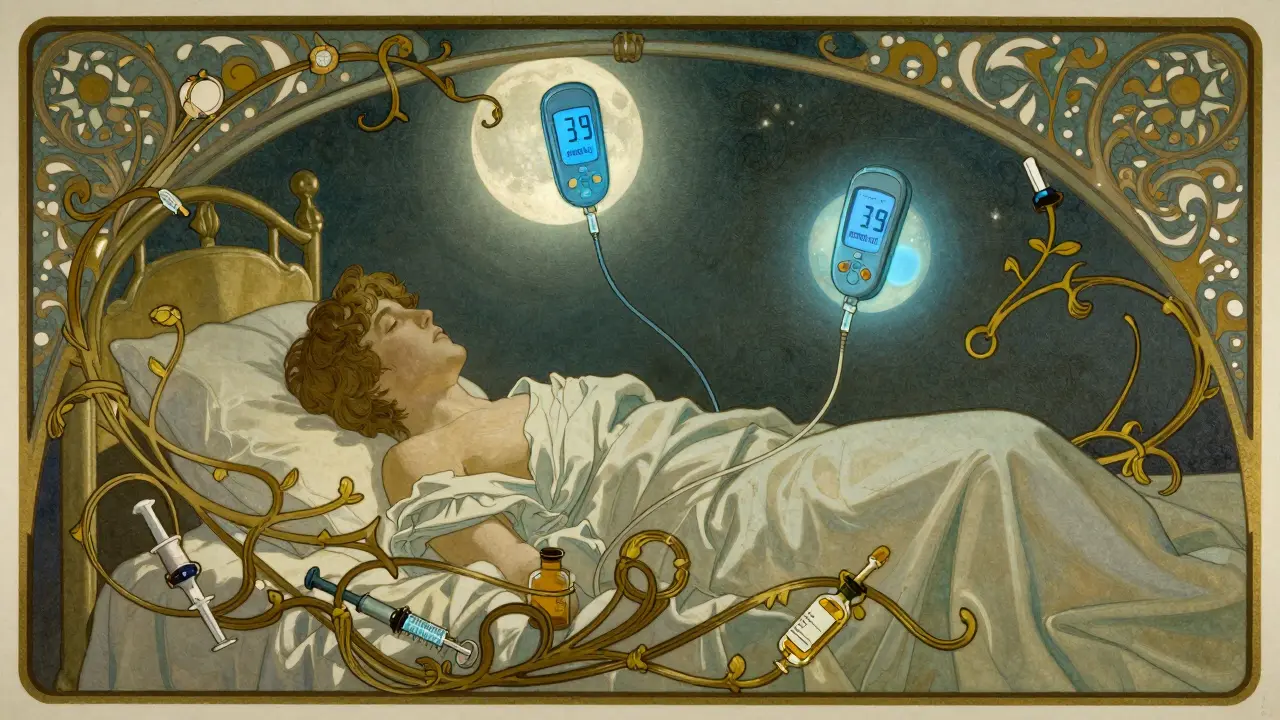
Hypoglycemia means your blood sugar drops below 70 mg/dL (3.9 mmol/L). That’s the clinical cutoff. But what matters more is how it feels. One person might get shaky and sweaty. Another might feel dizzy, confused, or suddenly unable to speak. For some, it’s a wave of fatigue so deep they can’t stand up. And then there are the scary ones-seizures, unconsciousness, or waking up in the middle of the night with a pounding heart and soaked sheets.The Diabetes Control and Complications Trial (DCCT) showed that people on intensive insulin therapy had three times more severe low blood sugar episodes than those on standard care. Type 1 diabetes patients averaged 2-3 severe hypos per year. That’s not rare. That’s routine. And for many, it’s the reason they avoid tight control. They’d rather live with higher numbers than risk passing out while driving, working, or alone at home.
Why It Happens
Insulin doesn’t have an off switch. Unlike oral meds, it keeps working even when you skip a meal, exercise harder than planned, or miscalculate your dose. A small error-1 extra unit, a delayed lunch, or a 10-minute walk after dinner-can send blood sugar crashing. The body reacts with adrenaline, cortisol, and glucagon trying to fight back. That’s why you feel your heart racing, your palms sweating, your hands trembling. Your body thinks it’s in danger. And it is.Over time, some people lose their warning signs. This is called hypoglycemia unawareness. About 25% of long-term type 1 patients develop it after 15-20 years. They no longer feel the tremors or sweat. They just wake up confused-or worse, find themselves in the hospital with no memory of what happened.
Why Insulin Makes You Gain Weight
The Science Behind the Scale
Insulin isn’t just a glucose shuttle. It’s a storage hormone. When you take insulin, your body stops breaking down fat and starts storing it. Before insulin, your body was burning through glucose because it couldn’t use it. Now, with insulin, that glucose gets absorbed-into your muscles, liver, and yes, your fat cells.Plus, before insulin, high blood sugar meant glucose spilled out in your urine. You were literally peeing away calories. Once insulin kicks in, that stops. Every gram of sugar you eat now stays in your body. It’s not magic-it’s biology.
Studies show most people gain 4-6 kg (9-13 lbs) in the first year of starting insulin. Some gain more. Some gain less. It depends on how much you eat, how active you are, and whether you adjust your calories to match your new insulin dose. A 2023 review in Endocrine Practice found that patients who received early nutritional counseling gained only 2.8 kg on average-nearly half as much as those who didn’t.
It’s Not Just Fat
Weight gain isn’t just about appearance. It makes insulin resistance worse. More fat means your body needs more insulin to do the same job. That creates a cycle: more insulin → more weight → more insulin → more weight. It’s one of the reasons many patients start skipping doses. They think, “If I take less insulin, I won’t gain weight.” But here’s the trap: skipping insulin raises blood sugar, which leads to more fatigue, more hunger, more cravings, and eventually, even more weight gain. It’s a dangerous loop.How to Prevent and Manage Hypoglycemia
Monitor, Don’t Guess
Self-monitoring blood glucose (SMBG) is the first line of defense. Four to six checks a day isn’t excessive-it’s smart. But even better is continuous glucose monitoring (CGM). Devices like Dexcom G7 or Freestyle Libre don’t just show numbers-they show trends. You can see if your sugar is dropping fast after lunch or creeping low overnight. CGMs reduce severe hypoglycemia by 40-50% in clinical trials.Set alerts. Don’t ignore them. If your CGM beeps at 3.5 mmol/L, eat something. Don’t wait for shaking or sweating. That’s too late.
Know Your Triggers
Common causes:- Too much insulin for your food
- Delayed or missed meals
- Increased physical activity without adjusting insulin or carbs
- Alcohol, especially on an empty stomach
- Insulin timing errors (e.g., taking rapid-acting too early)
Keep a log. Not just numbers-context. What did you eat? When did you exercise? Did you sleep poorly? Patterns emerge over time. And once you see them, you can adjust.
Emergency Prep
Everyone on insulin should have a glucagon kit. It’s not optional. Glucagon is a hormone that quickly raises blood sugar. It comes in injectable or nasal forms (like Baqsimi). Teach your partner, your coworker, your neighbor how to use it. If someone is unconscious and you can’t get a glucose gel into their mouth, glucagon is your only option. Call emergency services if they don’t respond within 10 minutes. And wear a medical ID bracelet. It could save your life.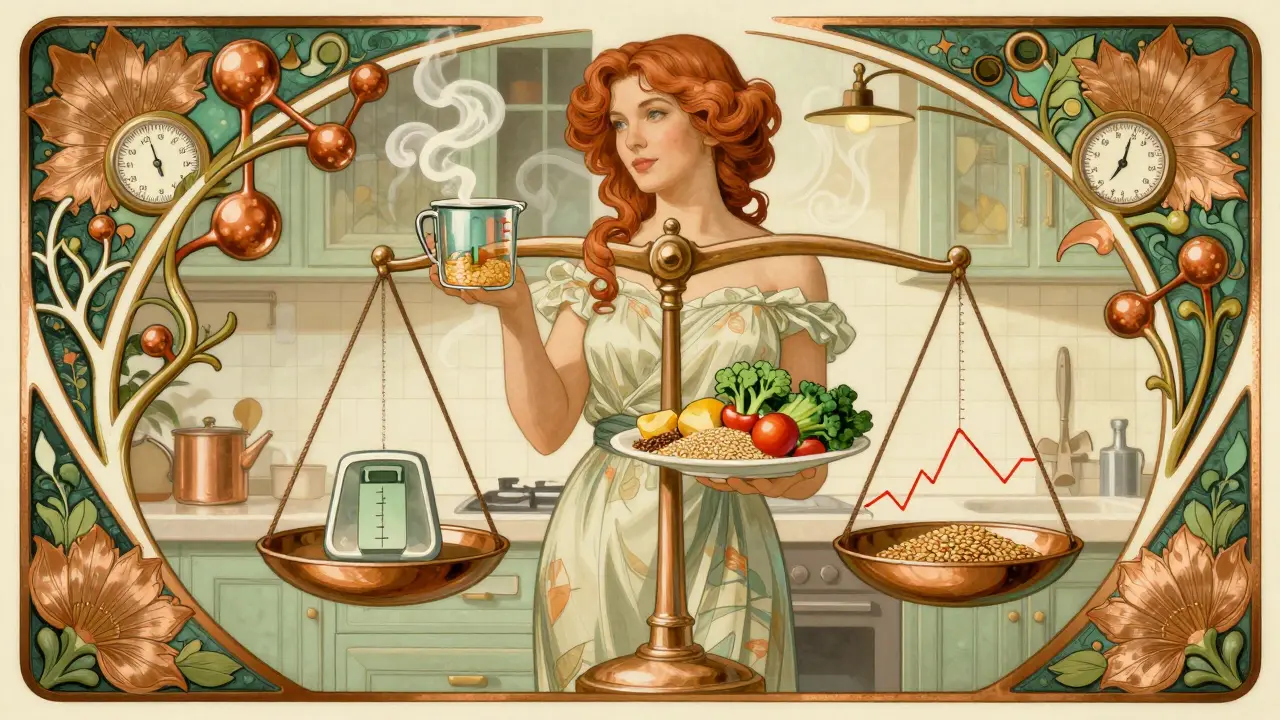
How to Manage Weight Gain Without Sacrificing Control
Food First
You can’t out-exercise a bad diet. But you can out-eat insulin. The key isn’t restriction-it’s precision.- Match carbs to insulin. Learn your insulin-to-carb ratio. If 1 unit covers 10g of carbs, don’t eat 15g without adjusting.
- Choose low-glycemic foods. Whole grains, legumes, non-starchy vegetables, nuts. They release sugar slowly, reducing spikes and crashes.
- Watch portion sizes. Even healthy foods add up. Use measuring cups or a food scale for a few weeks. It’s eye-opening.
- Don’t treat every low with 15g of glucose. Sometimes 5g is enough. Overcorrecting leads to rebound highs, then more insulin, then more weight gain.
Medication Help
You don’t have to choose between insulin and weight loss. GLP-1 receptor agonists like semaglutide (Ozempic) and liraglutide (Victoza) are now commonly paired with insulin. These drugs slow digestion, reduce appetite, and help you lose 5-10 kg over 30 weeks. Studies show they cut insulin doses by 15-20% while improving blood sugar control. They’re not magic, but they break the cycle.Move More, Not Harder
You don’t need to run marathons. Just move consistently. A 20-minute walk after meals lowers post-meal spikes. Strength training twice a week builds muscle, which improves insulin sensitivity. Muscle burns more glucose than fat. More muscle = less insulin needed = less weight gain.The Bigger Picture: Balancing Risk and Reward
The DCCT proved that tight control cuts blindness, kidney failure, and nerve damage by 76%. That’s huge. But it also doubled the risk of severe lows. So what’s the answer? Individualization.Not everyone needs an A1c of 6.5%. For older adults, those with heart disease, or those with frequent hypos, an A1c of 7.5-8.0% is safer and just as effective long-term. The goal isn’t perfection. It’s sustainability. It’s living without fear.
Modern tools help. Ultra-long-acting insulins like degludec (Tresiba) reduce nighttime lows by 40% compared to older insulins. Closed-loop systems (artificial pancreas) cut time in hypoglycemia by 72%. These aren’t sci-fi-they’re available now. But they’re expensive. Access remains unequal. Still, if you can get them, they change everything.
What Patients Say-And What They Don’t
In clinics, patients rarely say, “I love my insulin.” They say, “I’m scared to go to sleep.” “I don’t trust my CGM anymore.” “I stopped using insulin for a while because I gained 12 kilos.”That fear is real. That guilt is real. And it’s why non-adherence is so common. One study found 18% of insulin users intentionally underdose to avoid weight gain. Another 15% skip doses after a hypo to “punish” themselves. These aren’t lazy people. They’re exhausted. They’re afraid. They’re trying to protect their bodies, their dignity, their lives.
Good care doesn’t just fix blood sugar. It addresses fear. It talks about weight without shame. It gives people tools-not guilt.
Final Thoughts: You’re Not Alone
Hypoglycemia and weight gain aren’t failures. They’re side effects of a powerful treatment. And they’re manageable-with the right support, the right tools, and the right mindset.You don’t have to choose between safety and control. You can have both. But it takes work. It takes education. It takes talking to your care team about your fears, not just your numbers.
Start today. Ask for a CGM. Ask for a dietitian. Ask about GLP-1 drugs. Ask for help with fear. Your body is fighting hard. You should too.
John Haberstroh 16.02.2026
I've been on insulin for 8 years, and honestly? The weight gain hit me like a freight train. I went from 165 to 210 in 9 months. No one warned me it'd be this hard. I thought it was just 'eating less'-but no, it's biology. Insulin's a storage hormone, not a magic bullet. I started doing post-meal walks and it helped. Not magic, but real. Still hate the scale, though.
Agnes Miller 16.02.2026
I just want to say… i forgot the hyphen in hypoglycemia in my log yesterday. again. sorry. but i did catch a low before it got bad thanks to my libre. small wins.
Haley DeWitt 16.02.2026
I just started insulin last month, and I’m already terrified of lows!! 😰 I had one last week after a walk-I thought I was dying. My CGM screamed at me at 63, and I ate 4 glucose tabs. Then I felt worse. Why?! I’m so confused. Someone please tell me I’m not alone.
Carrie Schluckbier 16.02.2026
Let’s be real-Big Pharma knew insulin caused weight gain and hypoglycemia. They didn’t fix it. They just sold us CGMs and glucagon pens for $800 a pop. The real solution? Stop insulin. Try keto. Try fasting. Try not letting corporations control your pancreas. They don’t care if you pass out. They care if you buy another box.
guy greenfeld 16.02.2026
There’s a metaphysical layer here, you know? Insulin isn’t just a hormone-it’s a symbol of surrender. We surrender autonomy to a needle. We surrender our bodies to a system that says, ‘Here, take this, and trust us.’ But what if trust is the real side effect? What if the weight gain isn’t fat… but grief? Grief for the body we thought we’d keep. Grief for the freedom we lost.
Steph Carr 16.02.2026
Oh sweet merciful chaos, another post that treats diabetes like a spreadsheet. ‘Match carbs to insulin.’ Sure, Jan. Try doing that when you’re 72, blind in one eye, and your grandkid just spilled grape juice on your shirt. I take insulin. I gain weight. I get lows. I cry. I eat a damn cookie anyway. You don’t need a PhD to live with this. You just need someone to say, ‘Yeah, it sucks. Me too.’
Brenda K. Wolfgram Moore 16.02.2026
You’re not weak for fearing lows. You’re not lazy for gaining weight. You’re not broken. You’re human. And you’re doing better than you think. I started with 30 units a day. Now I’m at 18. I lost 15 lbs. Not because I’m perfect. Because I kept showing up. Even on the days I wanted to quit. You’re not alone. Keep going.
James Lloyd 16.02.2026
The article correctly identifies insulin’s dual role as a glucose transporter and a lipogenic agent. However, it underemphasizes the role of circadian rhythm disruption in weight gain. Nighttime insulin dosing, especially with intermediate-acting analogs, coincides with reduced metabolic rate and increased fat storage efficiency. Studies from 2022 (e.g., Diabetologia) show that shifting basal insulin to morning hours reduces adiposity by 18% in non-obese T1D patients. Consider chronotherapy.
Digital Raju Yadav 16.02.2026
In India, we don’t have these problems. We eat rice, we work hard, we don’t whine about weight. Your insulin is too strong. You eat too much bread. In my village, people with diabetes walk 8 km to work. No CGM. No glucagon. Just rice and discipline. Stop making excuses. This is a Western problem.
Liam Earney 16.02.2026
I just… I just want to say… I’ve been on insulin for 17 years… and I’ve had… five severe hypos… and… I… I… I lost my job because I passed out in the break room… and my wife… she… she doesn’t understand why I cry when I see a banana… and I… I… I just… I don’t know how to say this… but… I’m tired… so tired…
Adam Short 16.02.2026
I’m British. We don’t do ‘solutions.’ We do ‘muddling through.’ I’ve got a CGM, a glucagon kit, and a fridge full of GlucoTabs. I’ve gained 20 lbs. I’ve woken up in hospital twice. I still drive. I still work. I still drink. I still eat cake. I’m not fixed. I’m not cured. But I’m here. And that’s the British way.
Sam Pearlman 16.02.2026
Wait… so you’re saying GLP-1 drugs help? But didn’t Ozempic just cause people to lose weight? And now they’re saying it’s ‘magic’? What if Big Pharma is just replacing one drug with another? What if the real fix is not taking insulin at all? What if we’re all just lab rats in a $100 billion diabetes machine? 🤔
Linda Franchock 16.02.2026
I’m a nurse. I’ve seen this play out a hundred times. The patient cries. The doctor says, ‘Just reduce carbs.’ The patient does. Then they get a low. Then they eat 30g of sugar to fix it. Then they gain weight. Then they feel guilty. Then they skip insulin. Then they get DKA. We treat numbers, not people. We need to do better.
Prateek Nalwaya 16.02.2026
I’m from India, and we don’t have access to CGMs or GLP-1s. But we do have bitter gourd, fenugreek, and walking after meals. My A1c is 7.1. I don’t use insulin anymore. I use food. I use movement. I use tradition. Science is great, but wisdom is older.
Dennis Santarinala 16.02.2026
I’ve been doing this for 12 years. I used to think I had to be perfect. Now I just try to be consistent. I eat. I move. I check. I rest. I cry. I laugh. I sleep. I wake up. I do it again. It’s not about control. It’s about showing up. Even when it hurts. Even when you’re tired. Even when the scale says ‘no.’ You’re still winning.