

Most people think athlete’s foot is just a bad case of itching between the toes. But if you’ve had it, you know it’s more than that. It can turn into cracked, peeling skin, burning so bad you can’t wear shoes, or even a rash that spreads up your ankle. And the worst part? It keeps coming back-even after you think it’s gone. The good news? Over-the-counter (OTC) antifungal treatments work if you use them right. Most cases clear up completely with the right product and consistent use. But too many people skip steps, stop early, or pick the wrong formula-and that’s why it never fully disappears.
What Causes Athlete’s Foot?
Athlete’s foot, or tinea pedis, isn’t caused by being dirty. It’s a fungal infection, mostly from Trichophyton rubrum, a type of fungus that thrives in warm, damp places. Think locker rooms, public showers, sweaty sneakers, or even damp socks left in a gym bag. The fungus doesn’t care if you’re an athlete or not-it just wants moisture and warmth. Around 15-25% of people worldwide have it at any given time, and it’s way more common in humid climates. In places like Perth, where summers are hot and humid, it’s a real problem.
The infection usually starts between the toes, especially the fourth and fifth. That’s where sweat gets trapped. If you don’t dry your feet properly after showering or sweating, the fungus takes over. Left untreated, it can spread to the soles, nails, or even your hands if you scratch. It’s contagious, but not because you’re gross. It’s because fungi are sneaky survivors.
OTC Antifungal Options: What’s Actually in These Products?
You’ll find a shelf full of creams, sprays, powders, and gels at any pharmacy. But not all are created equal. The active ingredients make all the difference. Here’s what’s really in them:
- Terbinafine (Lamisil AT): 1% cream or spray. Fungicidal-it kills the fungus, doesn’t just slow it down. Works in 24-48 hours. Only needs once-daily use.
- Clotrimazole (Lotrimin): 1% cream or spray. Fungistatic-it stops growth but doesn’t kill fast. Needs twice-daily use for 2-4 weeks.
- Miconazole (Micatin): 2% cream or powder. Similar to clotrimazole. Good for mixed infections (fungus + yeast).
- Tolnaftate (Tinactin): 1% cream or powder. Older formula. Less effective on thick, sole infections but great for damp areas between toes.
- Undecylenic acid: 25% in powders. Mild, works as a drying agent. Often used in prevention, not treatment.
According to a 2007 review of 50 clinical trials, terbinafine has the highest cure rate: 83%. Clotrimazole? 74%. Tolnaftate? Only 67%. That’s not a small gap-it’s the difference between clearing up in 7 days or dragging on for weeks.
Which One Should You Pick?
There’s no single best product for everyone. It depends on your infection type.
- Mild, between-the-toes infection? Try terbinafine cream once daily for 1-2 weeks. It’s fast, simple, and proven.
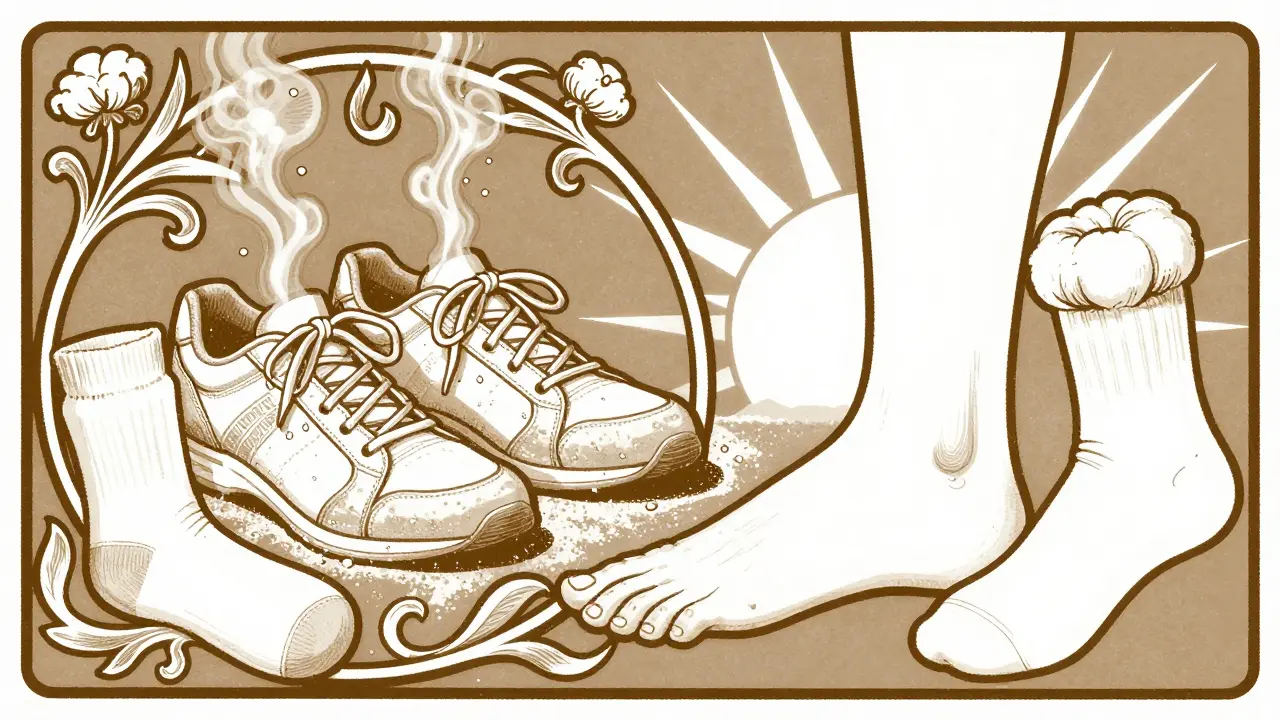
- Wet, soggy skin with peeling? Use a tolnaftate powder or spray. It dries things out while fighting fungus. Pair it with fresh cotton socks twice a day.
- Thick, scaly soles (moccasin type)? Clotrimazole twice daily for 4 weeks. Terbinafine alone might not cut it here. The fungus hides deep in the skin.
- Recurring infections? Use tolnaftate powder daily in shoes and socks-even after the rash is gone. Prevention is cheaper than repeated treatment.
Most people go for the cheapest option. But if you’re going to spend $8 on a tube, make sure it’s the one that works. Terbinafine costs $18-$25, but it’s often done in 7 days. Clotrimazole is $10-$15, but you’ll use it for 4 weeks. The math? Terbinafine wins on total cost and time.
How to Apply It Correctly (Most People Get This Wrong)
Applying antifungal cream like lotion? That’s why it doesn’t work.
Here’s the correct method:
- Wash your feet with soap and water. Don’t just rinse-scrub between the toes.
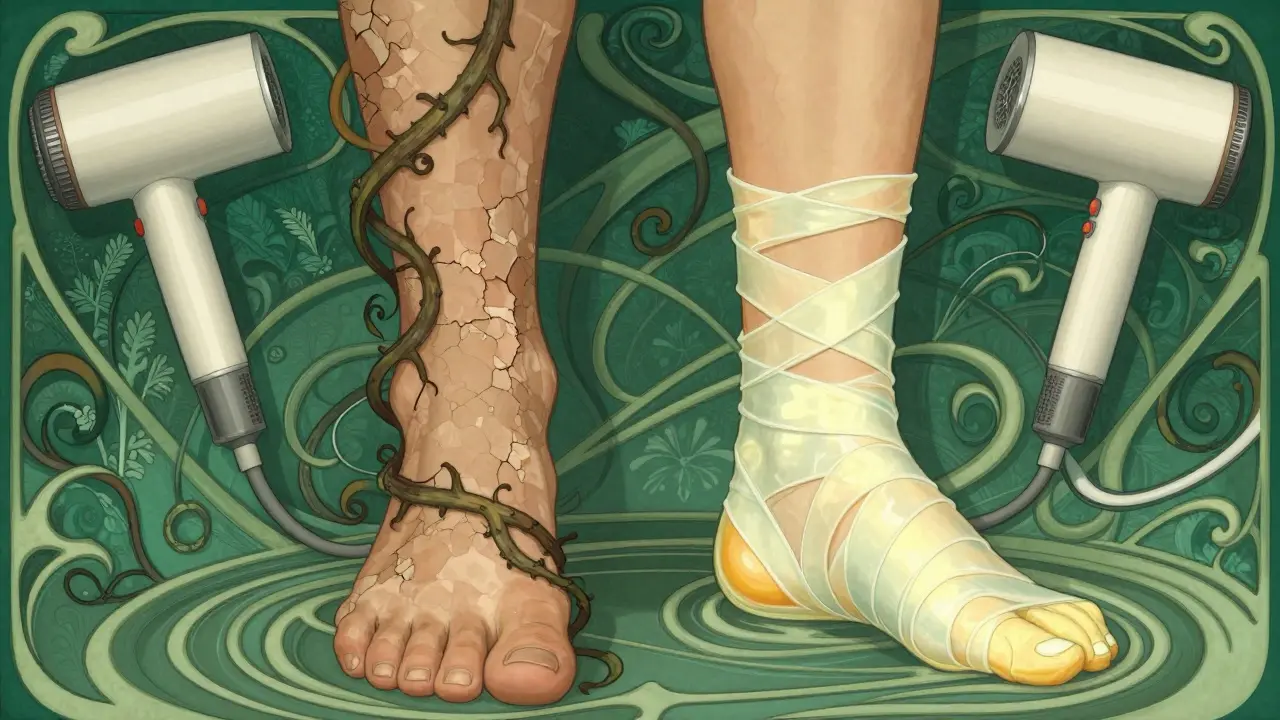
- Dry them completely. Use a separate towel just for your feet. Then, use a hairdryer on cool for 2-3 minutes. Moisture is the enemy.
- Apply a thin layer of cream or spray to the infected area and a 1-inch border around it. Fungus hides just outside the visible rash.
- Wait 5 minutes before putting on socks or shoes.
- Continue treatment for at least 1-2 weeks after symptoms disappear. Stopping early is the #1 reason it comes back.
Common mistakes:
- Applying too thickly (it doesn’t absorb better-it just sits there and irritates).
- Only treating the infected foot. Fungus is likely on both feet. Treat both.
- Not changing socks daily. Sweat-soaked socks are a fungal paradise.
- Wearing the same shoes every day. Fungi live in shoes. Rotate them. Let them dry out for 48 hours between wears.
When to See a Doctor
Most cases don’t need a doctor. But some do. Get help if:
- You’ve used the same OTC product for 2 weeks and it’s not improving.
- Your skin is oozing pus, swollen, or painfully red. That’s a bacterial infection-needs antibiotics.
- You’re diabetic or have poor circulation. Even a small fungal infection can turn dangerous.
- The infection spreads to your nails or more than half your foot.
Doctors can prescribe oral antifungals like terbinafine pills (250mg daily for 2 weeks) or topical ciclopirox. These work when the fungus is too deep for creams to reach. Oral terbinafine costs around $18 with a discount-cheaper than years of failed OTC treatments.
Prevention: The Real Secret
Prevention isn’t optional. It’s the only way to stop this from becoming a yearly ritual.
- Wear flip-flops in public showers and pools. Reduces transmission by 85%.
- Change socks twice a day. Cotton is best. Moisture-wicking synthetics work too.
- Use antifungal powder in shoes every day. Even when you’re not infected. Tolnaftate powder costs under $9 for a 30g container.
- Let shoes air out for 48 hours between wears. Rotate at least 2 pairs.
- Don’t share towels, shoes, or nail clippers.
A 2018 study found that daily antifungal powder use cuts recurrence by 63%. That’s not a suggestion. That’s science.
What the Experts Say
Podiatrists and dermatologists agree: terbinafine is the gold standard for uncomplicated athlete’s foot. It kills the fungus faster, requires fewer applications, and has higher cure rates. Mayo Clinic’s 2023 guidelines call it "very effective" and recommend it as first-line treatment.
But they also warn: "Consistency beats potency." A Reddit user named ActiveRunner87 said terbinafine cleared their infection in 6 days-but only because they dried their feet with a hairdryer every single time. Skip one day? Setback. Two days? Back to square one.
Clotrimazole still has value. If you have a mixed infection (fungus + yeast), it’s broader in coverage. And for people with arthritis or shaky hands, once-daily terbinafine is easier to stick with than twice-daily creams.
What’s Next? The Future of Treatment
Researchers are working on better delivery systems. Nanoemulsions in clinical trials could boost skin absorption by 40%, cutting treatment time to 3-5 days. Some new OTC products now combine antifungals with dimethicone-a barrier that locks out moisture.
But the biggest threat? Resistance. Terbinafine resistance in fungi has jumped from 0.2% in 2010 to 1.7% in 2023. That’s still low, but it’s rising. That’s why using the right product, for the full time, matters more than ever.
Final Takeaway
OTC athlete’s foot treatments aren’t magic. They’re tools. And like any tool, they only work if you use them the right way. Pick terbinafine for speed and simplicity. Use clotrimazole if you’re dealing with wet, stubborn soles. Apply it correctly. Dry your feet. Change your socks. Rotate your shoes. Keep going even after the itch is gone. Most cases clear up completely. But only if you don’t cut corners.
David L. Thomas 10.03.2026
Terbinafine’s 83% cure rate is wild when you consider how many people just slap on clotrimazole and call it a day. The science here is undeniable-fungus doesn’t care about your schedule, and neither should you. Consistency isn’t a suggestion, it’s a biological requirement.
Also, the hairdryer trick? Genius. Most people think drying feet means ‘kinda dry.’ Nah. You need to evaporate the moisture like you’re preparing for a spacewalk. Moisture is the root, not the symptom.
Miranda Varn-Harper 10.03.2026
I find it deeply concerning how casually people treat fungal infections as if they’re a minor inconvenience. This is not a pimple. This is a systemic biological invasion that, left unchecked, can lead to secondary bacterial infections, especially in immunocompromised individuals. The fact that OTC products are marketed as ‘easy fixes’ is a public health liability.
And yes, I’m aware that terbinafine is statistically superior-but that doesn’t excuse the lack of regulation around labeling and usage instructions. People are dying from neglect because the system treats this like a cosmetic issue.
Alexander Erb 10.03.2026
Yesss!! This is the most practical guide I’ve ever seen. I used to think athlete’s foot was just ‘gross feet’ until I tried terbinafine + hairdryer + new socks daily. Changed my life.
Also, rotating shoes? Non-negotiable. I’ve got 3 pairs now and I rotate like I’m a sneakerhead. My feet haven’t acted up in 2 years. 🙌
Donnie DeMarco 10.03.2026
man i used to think i was the only one who had this problem until i read this. i used to just wash my feet and hope for the best. then i tried the tolnaftate powder in my shoes and holy crap it’s been 6 months and no itching. i even put it in my work boots now. best $8 i ever spent. also, don’t share towels. that’s just asking for trouble.
Tom Bolt 10.03.2026
There is a fundamental flaw in the entire OTC paradigm: the assumption that the user has the cognitive capacity, discipline, and environmental control to follow a 4-week regimen. This is not a medical issue-it is a socioeconomic one. People working two jobs, living in shared housing, without access to dryers or multiple pairs of shoes, are being set up to fail. The real solution isn’t better antifungals. It’s housing policy, public hygiene infrastructure, and access to affordable healthcare.
And yet, here we are, blaming the patient.
Gene Forte 10.03.2026
Let me be clear: this isn’t about chemistry. It’s about commitment. Fungal infections don’t vanish because you applied cream once. They vanish because you showed up every single day, even when it felt pointless.
Think of it like brushing your teeth. You don’t stop because the plaque is gone. You keep going because you know what happens if you don’t.
Terbinafine works because it’s precise. But it only works if you’re consistent. That’s not science-it’s character.
And yes, dry your feet. With a hairdryer. No excuses.
Shourya Tanay 10.03.2026
As someone from a humid region with frequent monsoons, I’ve struggled with this for over a decade. The advice about drying feet with a hairdryer is revolutionary in my context-most clinics here don’t even mention it. The powder-in-shoes routine has been a game-changer. I now use it prophylactically, even when asymptomatic.
I also appreciate the distinction between fungicidal and fungistatic agents. Many patients are unaware that their ‘treatment’ is merely suppressing the infection, not eradicating it. This level of clarity is rare in public health communication.
Adam Kleinberg 10.03.2026
Let’s be honest-this whole OTC market is a scam. Terbinafine works? Sure. But did you know the FDA approved it after a 3-month trial with 127 people? And the studies were funded by the manufacturer? And the ‘63% reduction in recurrence’? That number comes from a single 2018 study with no control group.
Meanwhile, Big Pharma is pushing these products because they’re addictive. You think you’re cured? You’re not. You’re just on maintenance. And the real cure? UV light therapy. But they don’t want you to know that because it’s free.
Wear copper socks. They kill fungus. Google it. They’ve been banned in 14 countries for being ‘too effective.’