
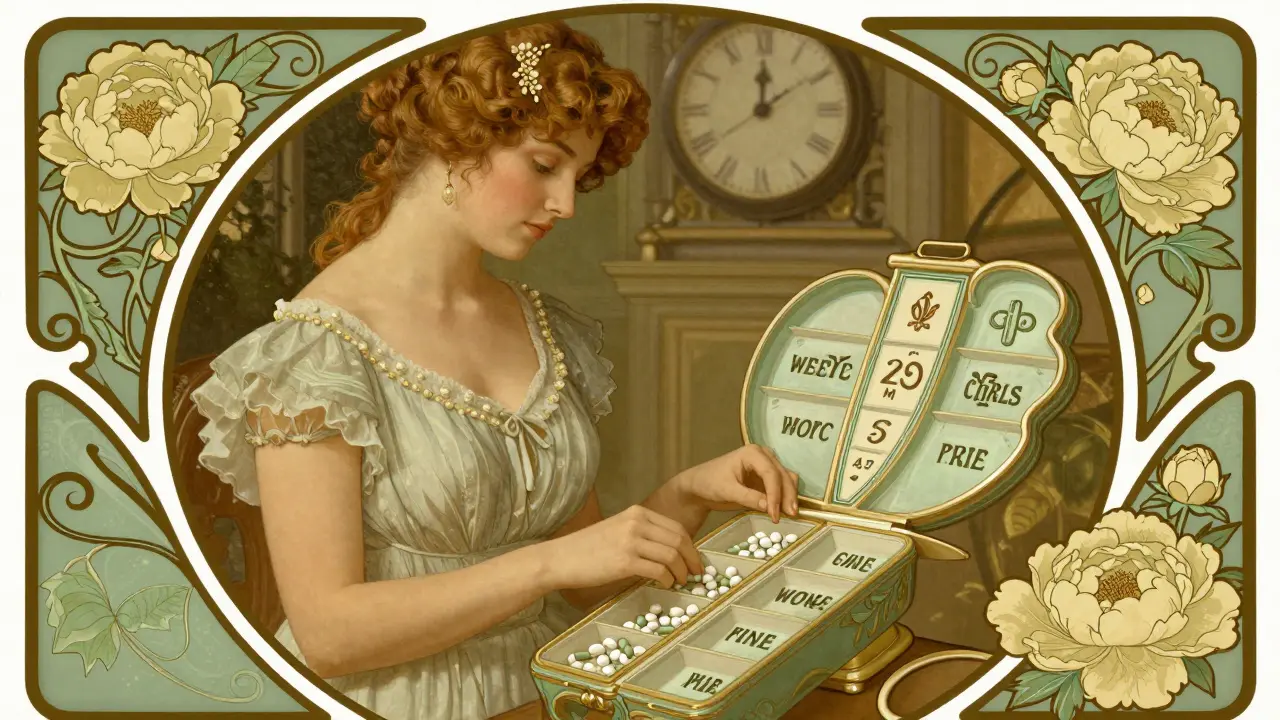
Half of all people taking medication for chronic conditions don’t take it as directed. Not because they’re careless. Not because they don’t care. But because life gets in the way-forgetting doses, juggling multiple pills, struggling with cost, or just feeling fine and thinking, "I don’t need this anymore." This isn’t a failure of willpower. It’s a system problem. And the good news? There are real, proven ways to fix it.
Why Medication Adherence Matters More Than You Think
Medication adherence isn’t just about taking your pills on time. It’s about staying alive. The World Health Organization says global adherence to long-term meds averages just 50%. In the U.S., poor adherence contributes to about 125,000 deaths every year. That’s more than traffic accidents. It’s also behind 30-50% of treatment failures for conditions like high blood pressure, diabetes, and heart disease. When you skip doses, your body doesn’t get the steady dose it needs. Your condition worsens. Hospital visits go up. Costs spike. And you’re at risk.
But here’s the twist: most people who miss doses aren’t rebels. They’re not ignoring doctors. They’re overwhelmed. A 2022 survey found 68% of patients forget doses. 42% say their regimen is too complicated. And 61% say cost is the biggest barrier. Adherence isn’t about discipline. It’s about design.
The Three Phases of Adherence (And Where People Drop Off)
Adherence isn’t one action. It’s three. And people fail at different points:
- Initiation: Did you fill the prescription? Many never even start. Cost, confusion, or fear can stop you before you begin.
- Implementation: Once you start, do you take it right? This is where forgetting, skipping doses, or doubling up happens.
- Discontinuation: When do you stop? Often, it’s because you feel better. But stopping early can make things worse-like stopping antibiotics before the infection is gone.
Fixing adherence means tackling each phase. Not just reminding you to take your pill. Making sure you can afford it. Making sure you understand why it matters. Making sure the schedule fits your life.
Why You’re Not Taking Your Meds (And What You Can Do)
There are two kinds of non-adherence: unintentional and intentional.
Unintentional means you meant to take it-but something got in the way. Maybe you:
- Forgot because you’re on 5+ meds
- Can’t read the label
- Can’t afford it
- Have trouble opening bottles
- Travel often
Intentional means you chose not to take it. Maybe you:
- Think the side effects are worse than the disease
- Don’t believe it works
- Think you’re cured
- Feel embarrassed to take meds in public
Here’s what works for each:
For Forgetfulness: Use a Pill Organizer
Blister packs and weekly pill organizers aren’t old-school-they’re science-backed. A Farmington Drugs survey found 73% of users said they were a "lifesaver." Choose one with clear labels and compartments for morning, afternoon, evening. Some even lock. If you travel, get a small daily one. Set a phone alarm. Pair taking your pill with brushing your teeth. Habit stacking works.
For Complexity: Simplify the Regimen
Each extra daily dose cuts adherence by about 2%. Four doses a day? Only 51% of people stick with it. One dose a day? 79%. Ask your doctor: Can we switch to a combo pill? Can we change from three times a day to once? Can we use a long-acting version? Pharmacists can help. Many can consolidate pills into one daily pack.
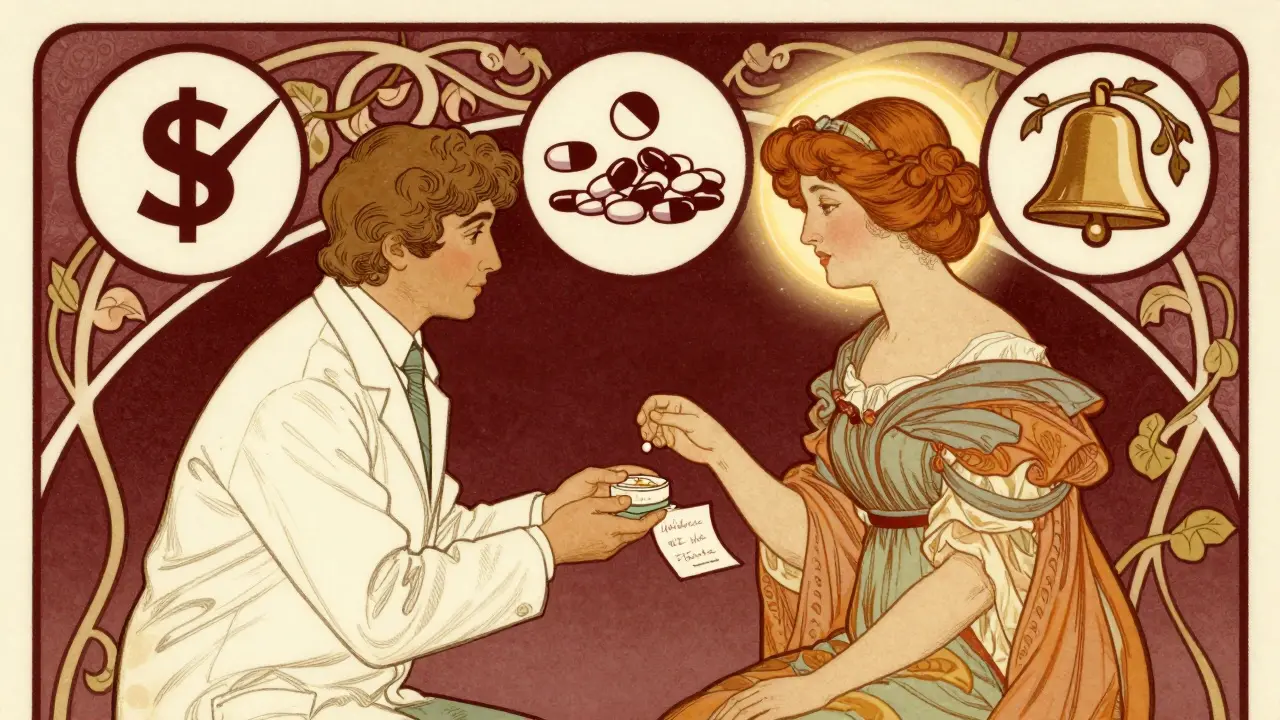
For Cost: Talk to Your Pharmacist
Cost is the #1 reason people skip doses. Generic versions? Yes. Mail-order? Yes. Manufacturer coupons? Often yes. Some pharmacies offer $4 generics for common meds. Ask about 90-day supplies-they often cost less per pill. If you’re on Medicare, check if your plan has a coverage gap (the "donut hole"). There are programs to help. Don’t suffer silently. Talk to someone.
For Misunderstanding: Ask the "Teach-Back" Question
Doctors assume you understand. You nod. But later, you’re confused. Try this: After your doctor explains, say, "Can you help me explain this back to you?" If you can describe why you take it and how, you’ll remember it better. Studies show this boosts understanding by 35%.
For Distrust: Challenge Your Beliefs
If you think meds are "just for show" or "making you dependent," you’re not alone. But beliefs aren’t facts. Ask: "What’s the evidence?" Look up your condition. Read what the CDC says. Talk to a pharmacist-they’re trained to explain risks without scare tactics. Sometimes, just hearing, "This drug cuts your stroke risk by 40%" changes everything.
Technology Can Help-If It Fits You
Apps like Medisafe, Mango Health, and AdhereCard send reminders, track doses, and even alert family members. One study found users improved adherence by 22%. But here’s the catch: 57% of people over 65 say smartphone apps are too hard. If you’re not tech-savvy, skip the app. Use a simple alarm clock. A pill box with a timer. A printed chart on the fridge. The best tool is the one you’ll actually use.
Electronic pill bottles that log when opened? They’re accurate-but expensive. Most insurance won’t cover them. Still, if you’re in a high-risk group (heart failure, diabetes, post-surgery), ask your doctor if one’s available through a program.
What Health Teams Are Doing Right
It’s not just you. The system needs to change too.
At Mayo Clinic, a heart failure program reduced hospital readmissions by 37% in 18 months. How? They:
- Assigned pharmacists to follow up within 48 hours of discharge
- Simplified dosing schedules
- Provided free pill organizers
- Called patients weekly for the first month
Another success? Team-based care. When pharmacists, nurses, and doctors work together-checking refill records, calling patients, adjusting meds-adherence jumps to 89%. That’s not magic. That’s coordination.
And here’s a secret: Knowing someone is checking on you makes you more likely to take your meds. The CDC says the mere fact that a clinician is monitoring adherence is almost as powerful as the intervention itself.

How to Start Today
You don’t need a program. You don’t need a tech gadget. Just three steps:
- Write it down. List every medication. Dose. Time. Why. Put it on your phone or a sticky note.
- Pair it. Link each pill to a daily habit. "After I brush my teeth, I take my blood pressure pill."
- Ask for help. At your next appointment, say: "I want to take my meds right. What can we do to make it easier?"
And if you’re helping someone else-parent, partner, friend-don’t nag. Ask: "What’s the hardest part?" Listen. Then help them fix it.
The Bottom Line
Medication adherence isn’t about being perfect. It’s about being consistent. Even if you miss a dose, don’t give up. Just take the next one. Talk to your pharmacist. Ask for help. Use a pill box. Cut down doses. Get generics. Use a reminder.
You’re not failing. The system is. But you have more power than you think. Taking your meds as prescribed isn’t obedience. It’s self-care. And it’s the single most effective thing you can do to stay healthy-especially if you’re managing a chronic condition.
Mayank Dobhal 7.02.2026
This is why I stopped taking my blood pressure meds. Cost. Pure and simple. $80 a month for a pill that does nothing but make me dizzy. I'd rather just eat less salt and deal with the headaches.
Ashley Hutchins 7.02.2026
I don't get why people think they need apps to remember to take pills like they're toddlers. Just put them next to your coffee maker or toothbrush. If you can't remember to brush your teeth, maybe you shouldn't be managing your own meds.
Savannah Edwards 7.02.2026
I've been on 7 different meds for 8 years now and let me tell you, the pill organizer was a game changer. But what really saved me was my pharmacist. She noticed I hadn't refilled my statin in 3 months and called me. Not a text. Not an email. A real phone call. She asked if I was okay. I cried. Turns out I was scared the side effects meant I was dying. She sat with me for 20 minutes and explained it was just muscle soreness. That human connection? That's what kept me going. Not the app. Not the alarm. Just someone who cared enough to check in.
Ariel Edmisten 7.02.2026
One dose a day. That's the goal. Simple. If your doc won't help you simplify, find a new one.
Mary Carroll Allen 7.02.2026
I used to skip my diabetes meds because I thought I was 'cured' after losing 30 lbs. Then I ended up in the ER with ketoacidosis. I didn't even know that was a thing. Now I keep a sticky note on my mirror that says: 'You're not cured. You're managing.' And I take my pill. Every. Single. Day.
AMIT JINDAL 7.02.2026
Lmao so many people are too lazy to take a pill but will spend 3 hours scrolling TikTok. I'm from India and we have like 10 people in a family sharing one phone and still they take meds on time. We don't have apps, we have discipline. America needs to stop coddling itself. 🤷♂️
Gouris Patnaik 7.02.2026
This whole post feels like a corporate wellness pamphlet. The real issue? Capitalism. You can't expect someone working two jobs, living paycheck to paycheck, with no healthcare access, to care about 'adherence' when they're choosing between insulin and groceries. The system isn't broken. It was designed this way. Stop blaming individuals and fix the economy.
Lakisha Sarbah 7.02.2026
I'm 67 and I use a pillbox with big letters and a wind-up alarm. I don't need a smartphone. I just need to not forget. And I do it. Every day. My grandkids help me refill it. It's not tech. It's family.
Heather Burrows 7.02.2026
I suppose if you're the type of person who needs reminders to take a pill, maybe you shouldn't be taking it at all. Some things are just too complicated for the average person. Maybe we should stop pretending everyone can manage chronic illness like it's a chore list.
Ritu Singh 7.02.2026
As someone raised in a household where medicine was seen as a last resort and not a daily ritual, I can say this: the cultural stigma around chronic illness in many communities is the real barrier. We are taught to endure, not to manage. To suffer in silence, not to ask for help. This article speaks of systems-but we must also speak of shame. My mother died because she believed taking insulin meant she had failed as a woman. We must heal the culture before we fix the regimen.