
One in seven new mothers experiences postpartum depression - not just feeling tired or overwhelmed, but drowning in sadness, guilt, or numbness after giving birth. It doesn’t happen because they’re not trying hard enough. It’s not a sign of weakness. It’s a medical condition, rooted in biology, triggered by life changes, and treatable. Yet too many women suffer in silence, thinking it’s just the ‘baby blues’ that will pass. But if those feelings last longer than two weeks, or get worse, it’s not normal. It’s postpartum depression.
What’s Really Going On With Hormones After Birth?
Right after delivery, your body undergoes one of the most dramatic hormonal shifts in human biology. Estrogen and progesterone - which soared during pregnancy - crash within 48 hours. By day three, they’re back to pre-pregnancy levels. That’s not a slow taper. That’s a freefall. This sudden drop affects your brain chemistry. Progesterone breaks down into allopregnanolone, a compound that calms your nervous system. When it vanishes, so does that natural sedative effect. Your brain is suddenly without its usual chemical cushion. Add to that a drop in oxytocin - the bonding hormone - and you’ve got a perfect storm for mood disruption. But here’s the twist: not every woman who goes through this hormonal crash gets depressed. And some women with postpartum depression don’t have extreme hormone fluctuations. That’s why experts no longer say hormones cause PPD. They say hormones trigger it in people who are already vulnerable. Think of it like a light switch. Hormones flip it. But what’s behind the wall - your genetics, past trauma, sleep deprivation, lack of support - determines whether the room goes dark.It’s Not Just About Moms
Postpartum depression doesn’t care if you gave birth. It doesn’t care if you’re cisgender, transgender, or nonbinary. It doesn’t even care if you adopted your baby. Studies show about 1 in 10 new fathers develop depression after a child is born. Adoptive parents face rates of 6-8%. And the risk doesn’t drop just because you didn’t carry the baby. The stress of sleepless nights, financial pressure, relationship strain - these hit everyone the same. The CDC found that American Indian and Alaska Native mothers experience PPD at more than 20% - nearly double the rate among non-Hispanic white mothers. Poverty, racism, lack of access to care - these aren’t just social issues. They’re biological risk factors. If you’re a new parent and you’re feeling off, it’s not ‘just stress.’ It’s a signal. And it’s not your fault.What Treatments Actually Work?
There are two kinds of treatments that work: those that fix your brain chemistry and those that fix your life. Medication: SSRIs like sertraline are the first-line treatment. They’re safe during breastfeeding, with minimal transfer to milk. Studies show they help 60-70% of women within 4-6 weeks. You don’t need to feel guilty about taking them. Just like insulin for diabetes, they’re replacing what your body can’t make enough of. Therapy: Cognitive behavioral therapy (CBT) has been proven to cut depression symptoms by over 50% in new mothers. It teaches you how to challenge thoughts like ‘I’m a terrible mom’ or ‘I should be happier.’ These aren’t facts. They’re symptoms. Specialized drugs: In 2019, the FDA approved brexanolone - an IV infusion of allopregnanolone - for severe cases. It works fast, sometimes in 24 hours. But it’s expensive and requires 60 hours of hospital monitoring. Then, in 2023, zuranolone came out - the first oral version. You take it for two weeks. No IV. No hospital stay. It’s changing the game. Other options: Transcranial magnetic stimulation (TMS) helps when meds and therapy don’t. It’s non-invasive, uses magnetic pulses to stimulate underactive brain regions, and has a 68% response rate in PPD patients. And yes - it’s covered by many insurance plans now.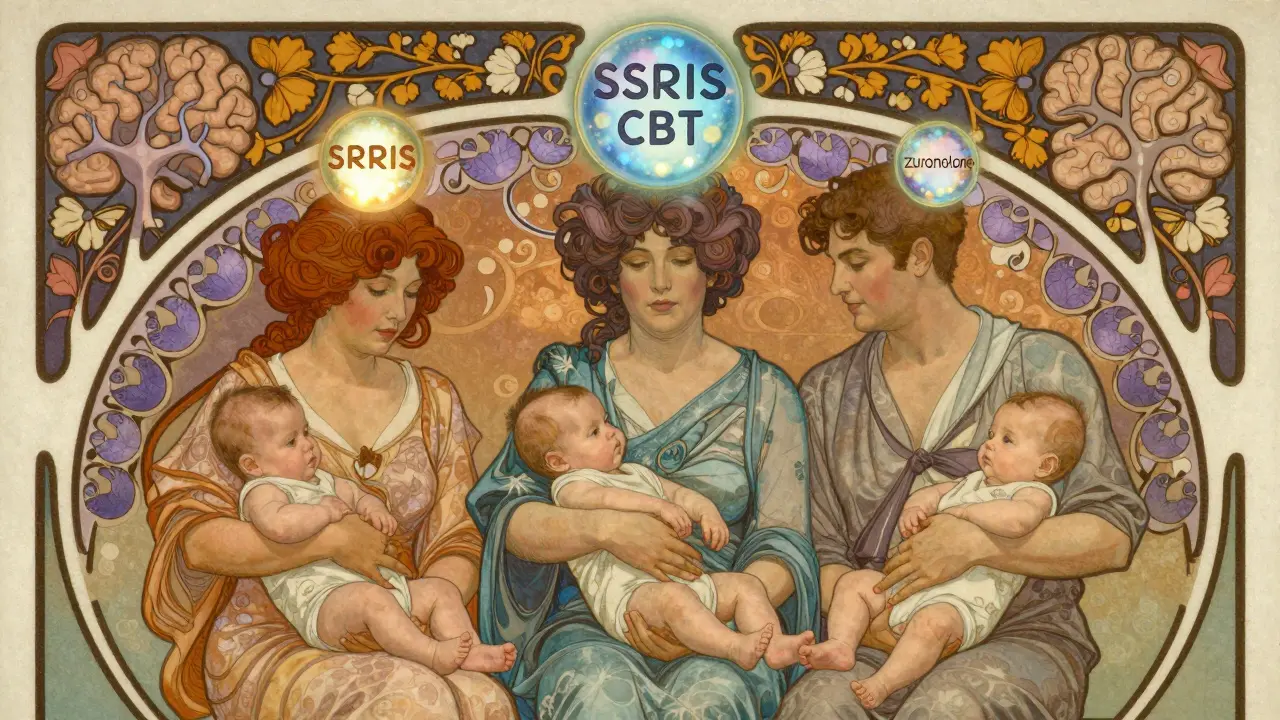
What Doesn’t Work (And Why)
You’ve probably heard: ‘Just take a nap.’ ‘Go for a walk.’ ‘Drink more water.’ These aren’t wrong - rest, movement, and hydration help. But they’re not treatments. They’re band-aids on a broken bone. Hormone pills? Estrogen patches? Progesterone creams? Some small studies showed promise. But large reviews found no consistent benefit. And they carry risks - blood clots, stroke, interference with milk supply. They’re not standard care for a reason. And please - don’t wait for it to get worse. If you’re crying every day, can’t get out of bed, or have thoughts of harming yourself or your baby - call someone today. This isn’t something you can ‘tough out.’Screening Is the First Step
Massachusetts made it law: every new mom gets screened for depression at her 2-week and 6-week checkups. The tool? The Edinburgh Postnatal Depression Scale. It’s simple. Five questions. Takes two minutes. Questions like: ‘I’ve been so unhappy that I’ve had difficulty sleeping.’ Or: ‘I’ve felt so sad that I’ve been crying.’ It’s not a test. It’s a lifeline. And it’s not just for moms. Dads, adoptive parents, surrogates - everyone should be asked. Yet most OB-GYNs say they feel unprepared to handle PPD. That’s why you need to speak up. If your provider doesn’t ask, ask them. Say: ‘I’ve been feeling really down. Can we talk about postpartum depression?’
Branden Temew 30.12.2025
So hormones are the match, but the real fire is everything else-trauma, isolation, sleep deprivation, the societal expectation that you should magically thrive while your body’s been through a war? Yeah. That’s the real tragedy. We treat PPD like a glitch in the system instead of a signal that the system’s broken. We give pills, sure-but who’s giving moms a break? Who’s giving them actual support? The fact that we need a drug that mimics a hormone we naturally lose after birth says everything about how little we value the biology of motherhood.
And yet, somehow, we still tell women to ‘just rest’ like it’s a weekend spa day and not a neurological earthquake.
Hanna Spittel 30.12.2025
ALLOPREGNANOLONE??? 😳 That’s just fancy science-speak for ‘your brain got robbed of its chill pill’ 🤡
Also, if you didn’t give birth but still feel like crap? Congrats-you’re a real parent now. 💀
anggit marga 30.12.2025
USA always makes everything about drugs and hospitals 🤦♀️ In Nigeria we just hold the baby close and let the village raise them. No IVs. No pills. Just food, songs, and elders telling you it’s normal to cry. You think science invented motherhood? No. Culture did.
Why are you treating biology like a broken phone that needs an upgrade?
Stop overmedicalizing pain
Joy Nickles 30.12.2025
Wait-so brexanolone is an IV that takes 60 HOURS??? 😭 I just got home from the hospital and my husband is already back at work and my mom says ‘you’re lucky you didn’t miscarry’ so I’m supposed to sit in a hospital for 2.5 DAYS while my baby is with a stranger???
Also-why is zuranolone not covered by my insurance?? I’ve been crying in the bathroom for 3 weeks and now you tell me the ONE pill that works costs more than my rent??
Also-did anyone mention that my partner didn’t cry once and now he’s ‘just stressed’?? I’m the one who’s been up every 2 hours and he’s getting a promotion??
Also-why does everyone say ‘it’s just hormones’ like I’m not allowed to be angry??
Also-I hate that I’m supposed to be grateful for this baby when I feel like I’m dying inside??
Also-why is no one asking me if I’m okay??
Also-why is this post so long??
Also-I’m so tired.
Emma Hooper 30.12.2025
Y’all are acting like PPD is some newfangled trend, honey. I’ve seen it in my cousin, my bestie, my yoga instructor, my barista who now gives me free lattes because she knows I get it. It’s not ‘sadness.’ It’s like your soul got vacuum-sealed in a plastic bag and left in the freezer. You can still smile. You can still feed the baby. But inside? You’re screaming into a pillow made of wet cotton.
And yes-dads get it too. My brother-in-law cried in the shower for three weeks straight after our niece was born. No one asked. No one said a word. He just started drinking more.
So if you’re reading this and you’re not crying-you’re either lying or you’re the lucky one. Either way-reach out. Don’t wait for the ‘perfect moment.’ There isn’t one.
And zuranolone? I’m saving my pennies. If it works, I’m buying a whole damn bottle for my sister-in-law. She deserves to feel like herself again.
Marilyn Ferrera 30.12.2025
Important note: SSRIs are safe during breastfeeding, but always consult your provider about dosage and timing. Some women report increased milk supply with sertraline; others notice a slight dip. Individual variation is normal.
Also: TMS is not experimental-it’s FDA-cleared for PPD since 2021. Many clinics offer sliding scale fees. Ask.
And yes-screening should be mandatory for all new parents, not just those who birth. Period.
One more thing: Gut microbiome research is promising, but still preliminary. Don’t start taking probiotics as a treatment yet-unless your doctor recommends it.
You’re not broken. You’re adapting. And help exists.
Robb Rice 30.12.2025
While I appreciate the comprehensive overview, I must note that the phrase 'you don't need to feel guilty about taking them' implies guilt is a common barrier-which it is-but the underlying cultural stigma around mental health treatment remains under-addressed in public discourse. We must normalize seeking help as a sign of strength, not weakness. Also, while zuranolone is groundbreaking, long-term data is still limited. Caution and monitoring remain essential.
Thank you for highlighting the need for systemic change, not just pharmacological fixes.
Deepika D 30.12.2025
Let me tell you something-when I had my twins in Delhi, my auntie didn’t give me pills. She gave me warm turmeric milk, massaged my feet with coconut oil, and made me sit in the sun every morning while the whole family took turns holding the babies. No one asked if I was ‘depressed.’ They just made sure I ate, slept, and didn’t carry anything heavy. And guess what? I didn’t spiral.
Here’s the truth: PPD isn’t just about biology. It’s about belonging. It’s about being held. In the West, we’ve outsourced motherhood to professionals and then wonder why we’re falling apart. We think therapy is the answer-but what if the answer is community? What if the answer is not being alone?
Yes, meds help. Yes, therapy helps. But what if the real treatment is a village? A meal delivered. A hand on your shoulder. A ‘I’ve been there too’ text at 3 a.m.? I’m not saying ditch the science-I’m saying weave it into the fabric of care. Because no pill can replace a human who shows up.
And if you’re reading this and you’re not a mom? Be the village. Bring soup. Hold the baby. Say nothing. Just be there.
And if you’re a dad? It’s okay to cry. It’s okay to be scared. You’re not failing. You’re learning. And you’re not alone.
Love isn’t perfect. But presence? Presence is everything.
Bennett Ryynanen 30.12.2025
My wife went through this and I didn’t know what the hell was happening. I thought she was just being dramatic. I was wrong. So fucking wrong.
One night she was just staring at the ceiling, rocking the baby, and whispering ‘I can’t do this.’ I didn’t say anything. I just sat down next to her. Held her hand. Didn’t try to fix it. Didn’t say ‘it’ll pass.’ Just sat there.
Next day I called the warmline. Made the appointment. Took the day off. Took the baby so she could sleep for 4 hours.
She took the pill. Went to therapy. We talked. We cried.
She’s better now.
But if I hadn’t shut up and just listened? She wouldn’t be.
So if you’re reading this and you’re a partner? Stop trying to solve it. Just be there.
And if you’re the one suffering? Call someone. Now. I’m not gonna judge you. Nobody here will.
You’re not weak.
You’re surviving.
And that’s enough.
Branden Temew 30.12.2025
Wow. Bennett’s comment just hit me like a brick. I spent 10 paragraphs theorizing about systemic failure-and here’s a guy who just said: ‘I sat with her.’
That’s the real treatment.
Not the IV. Not the pill. Not even the therapy.
Just someone who didn’t look away.
Thank you for saying that.
And to the rest of you-stop scrolling. Call someone. Now. Even if it’s just to say ‘I’m here.’
That’s how the light gets back in.